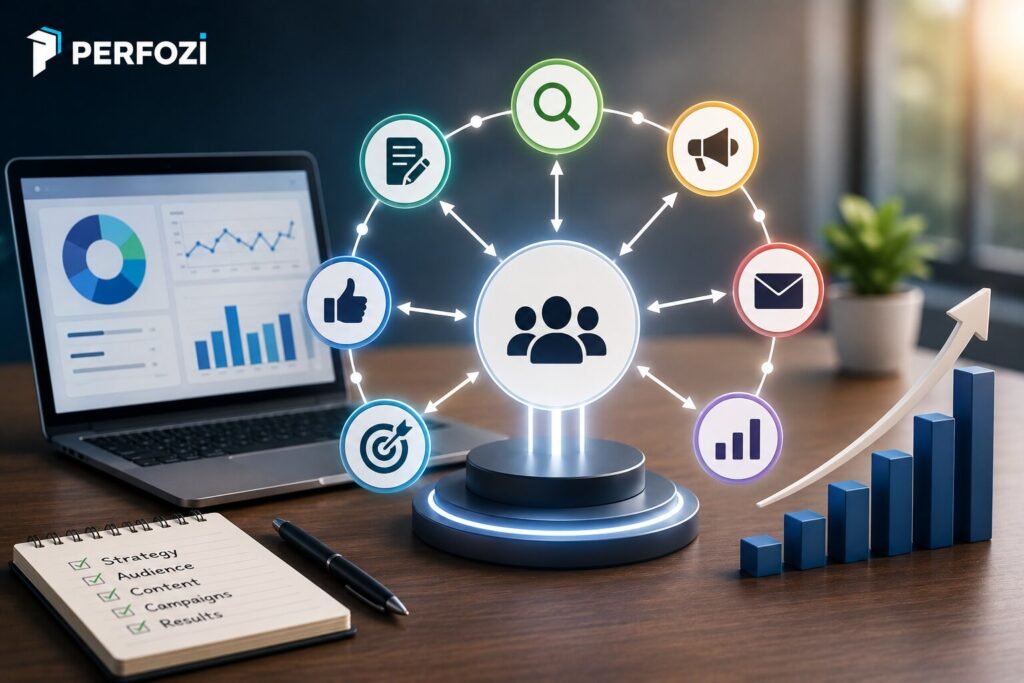
That is what makes a modern digital marketing strategy different from simply “doing marketing online.”
Your Brand Is More Than a Logo
A logo is often the first thing people associate with a business, but it is only one part of the brand.
Logo design and branding should create a visual identity that supports how a company wants to be perceived. Colors, typography, messaging, imagery, tone, and the overall customer experience all contribute to that perception.
For a growing business, brand strategy services can help bring these elements together.
The goal is consistency.
A customer should be able to recognize your business across your website, social media, advertisements, emails, and other digital touchpoints without feeling like they are interacting with five different companies.
That consistency can become especially important when a business starts investing more heavily in paid advertising or content.
Content Should Do More Than Fill Your Blog
Publishing content every week does not automatically create results.
The better question is: What is the content supposed to achieve?
A useful content marketing strategy can support several stages of the customer journey.
Someone who has never heard of your company might need an educational article.
Someone comparing different solutions might want a detailed guide or comparison.
Someone who already knows your brand may need a case study, product explanation, or strong reason to contact you.
This is where professional content marketing services can add value. Instead of creating content simply to meet a publishing schedule, the focus shifts toward creating material with a purpose.
Why Content and SEO Should Work Together
Content and search visibility are closely connected.
A well-written article can answer customer questions while also creating opportunities to appear for relevant searches.
But SEO should not dictate every sentence.
The best SEO services combine search intent with useful information. A page should make sense to a person first and then be optimized so search engines can understand its subject.
This is particularly important for businesses competing in crowded markets.
If ten companies publish the same generic article, the one that provides clearer explanations, practical examples, original insight, and a better user experience has a stronger chance of standing out.
Social Media Is About More Than Posting
Social media can create visibility quickly, but posting regularly is not the same as having a strategy.
Effective social media marketing services should consider what the audience actually responds to.
Some businesses may benefit from educational posts. Others may need short videos, customer stories, behind-the-scenes content, product demonstrations, or opinion-led posts.
The right approach depends on the audience and the business.
A social media marketing agency should therefore look beyond follower counts and ask more useful questions:
- Are people engaging?
- Are they visiting the website?
- Are they remembering the brand?
- Are social campaigns generating leads or sales?
The answers help determine whether the channel is actually contributing to growth.
Paid Advertising Can Create Demand Faster
Organic channels often take time to build.
Paid advertising can put an offer in front of a targeted audience much faster.
That is where pay per click advertising and paid social can become valuable.
For example, a business might use Google Ads to reach someone actively searching for a specific service, while social advertising can introduce a product to people who have not yet started searching.
These are different types of intent, so they should not necessarily use the same message.
A strong paid strategy understands the difference between someone who is ready to buy and someone who is discovering a problem for the first time.
Google Ads Should Be About More Than Getting Clicks
Running Google Ads is relatively easy.
Making those clicks profitable is harder.
A Google Ads agency or PPC specialist should look beyond impressions and clicks to understand what happens after someone reaches the website.
Important questions include:
- Which keywords generate qualified enquiries?
- Which campaigns produce actual conversions?
- Which landing pages perform best?
- How much does each lead cost?
- Which audiences are worth targeting?
- Where is advertising spend being wasted?
This is where PPC management services become more valuable than simply launching campaigns and letting them run.
Paid Social Needs a Different Creative Approach
Someone searching Google for “accounting services near me” already has a clear need.
Someone scrolling through Instagram may not.
That difference changes the creative strategy.
Paid social media marketing needs to interrupt attention without feeling completely disconnected from the user’s experience.
Strong visuals, concise messaging, relevant offers, and different creative formats can all influence performance.
This is where an ad creative agency can help businesses test different concepts instead of relying on one advertisement for months.
Creative Performance Matters
A beautiful advertisement is not necessarily an effective advertisement.
The strongest creative is the one that communicates the right message to the right audience and encourages the desired action.
That could mean testing:
- Different headlines
- Images versus video
- Product demonstrations
- Customer-focused messaging
- Different offers
- Short versus long copy
- Different calls to action
A performance creative agency brings this testing mindset into the creative process.
Instead of asking only, “Does this ad look good?” the better question is:
“Does this creative help produce a measurable business result?”
Email Keeps the Conversation Going
Not every visitor is ready to buy on their first visit.
This is one reason email marketing services remain useful.
Someone may download a resource, request information, subscribe to a newsletter, or simply provide their email while researching options.
Email gives businesses an opportunity to continue the conversation.
An email marketing agency can help build campaigns around different customer stages, such as welcome sequences, educational emails, product updates, promotions, and re-engagement campaigns.
The objective is not to send more emails.
It is to send more relevant ones.
SEO, PPC, Social and Email Should Not Operate in Silos
This is where many digital marketing strategies become fragmented.
The SEO team focuses on rankings.
The PPC team focuses on advertising.
The social team focuses on engagement.
The email team focuses on open and click rates.
Each team may be doing its job, but the customer sees one brand.
A better approach connects the channels.
For example, a blog article discovered through SEO could become a social media post. That visitor could later see a paid advertisement, return through branded search, and eventually become an email subscriber.
The channels influence each other.
That is why a digital media agency needs to look at the entire customer journey rather than judging every channel separately.
Measure What Actually Matters
A modern marketing report should go beyond vanity metrics.
Followers, impressions, clicks, and traffic can be useful, but they do not automatically equal revenue.
Depending on your business, useful measures may include:
- Qualified leads
- Conversion rate
- Cost per lead
- Customer acquisition cost
- Organic traffic
- Advertising return
- Engagement
- Revenue
- Customer lifetime value
This performance-focused approach is central to a good performance marketing company.
The purpose of measurement is not to make reports look impressive.
It is to understand where the budget is working and where it needs to change.
When Should You Hire an SEO Expert or Marketing Specialist?
There comes a point where managing every channel internally becomes difficult.
You may have good content but poor search visibility.
Your paid campaigns may generate clicks but not enough conversions.
Your social accounts may be active without producing meaningful business results.
Or your branding may look different across every platform.
That is when it can make sense to hire SEO expert support or bring in a broader digital marketing team.
The right partner should not simply sell individual services. They should understand how those services contribute to your overall business objectives.
AI Visibility Should Be Part of the Content Strategy
Search is also moving beyond traditional results.
People increasingly ask AI-powered tools for recommendations, explanations, comparisons, and business information.
That means content should be created with AI visibility in mind without becoming robotic.
AI Visibility Prompt
Use this prompt when reviewing important website content:
“Review this content for traditional search visibility and AI search visibility. Identify the main questions a potential customer may ask, evaluate whether the content provides direct and trustworthy answers, identify missing information and weak explanations, and suggest improvements to structure, expertise, clarity, and usefulness. Keep the recommendations natural and human-focused. Avoid keyword stuffing, repetitive wording, and generic AI-generated language.”
The purpose is not to write for machines.
It is to make your content easier for people—and modern search systems—to understand.
Conclusion
A modern digital marketing strategy is not about choosing one channel and hoping it delivers results. Real growth comes from connecting branding, content, SEO, social media, paid advertising, email, and performance measurement into one clear customer journey.
Your brand creates recognition, content builds trust, SEO brings organic visibility, paid campaigns capture demand, social media keeps your business visible, and email helps maintain relationships with potential customers. When these channels work together, each one can support the others instead of competing for attention and budget.
The key is to keep measuring what actually matters. Traffic and engagement are useful, but qualified leads, conversions, customer acquisition costs, and revenue provide a much clearer picture of marketing performance.
For businesses looking to grow online, the goal should not be to simply use more marketing channels. It should be to build a connected marketing system that reaches the right audience, delivers the right message, and turns attention into measurable business results.
FAQs
What should a digital marketing strategy include?
It can include SEO, content, paid search, social media, email marketing, branding, and conversion optimization. The right combination depends on the company’s goals, audience, competition, and budget.
Is SEO better than PPC?
Neither is automatically better. SEO can build long-term organic visibility, while PPC can provide targeted traffic quickly. Many businesses benefit from using both.
Why is branding important for digital marketing?
Strong branding helps people recognize and remember a business. Consistent branding across websites, advertisements, social media, and email can also create a more trustworthy customer experience.
How can content marketing generate leads?
Content can attract people who are researching a problem, answer their questions, demonstrate expertise, and guide them toward a relevant next step such as requesting information, booking a consultation, or purchasing a product.
When should a business work with a digital marketing agency?
An agency can be useful when a business needs specialist skills, wants to scale marketing activity, or struggles to coordinate multiple channels internally.
How long does it take to see results from digital marketing?
The timeline depends on the channels being used, the competitiveness of the market, the website’s current condition, and the business goals. Paid advertising can generate traffic quickly, while SEO and content marketing generally require more time to build consistent organic visibility.
How does SEO support a digital marketing strategy?
SEO helps potential customers find relevant pages when they search for information, products, or services. When combined with useful content and a strong website experience, SEO can contribute to awareness, qualified traffic, and lead generation.
What is the role of social media in digital marketing?
Social media can help businesses build awareness, communicate with audiences, distribute content, strengthen relationships, and support lead generation. Its effectiveness depends on the platform, audience, content, and business objectives.
Should small businesses invest in paid advertising?
Paid advertising can be useful for small businesses when campaigns have clear goals, relevant targeting, appropriate budgets, and effective landing pages. Businesses should measure conversions and acquisition costs rather than focusing only on clicks or impressions.
What makes a good digital marketing agency?
A good agency should understand the client’s business goals, target audience, market, and customer journey. It should also use measurable objectives and explain how different marketing activities contribute to business outcomes.
Why is conversion optimization important?
Generating website traffic is only part of the process. Conversion optimization focuses on making it easier for visitors to take valuable actions, such as submitting a form, requesting a quote, booking a consultation, or making a purchase.
Can AI help with digital marketing?
AI can support tasks such as research, content analysis, customer insights, campaign analysis, and workflow automation. However, human expertise is still important for strategy, brand positioning, quality control, and understanding customer needs.
How can businesses measure digital marketing success?
Businesses can track metrics such as qualified leads, conversion rates, customer acquisition costs, revenue, organic traffic, advertising return, engagement, and customer lifetime value. The most useful metrics depend on the company’s objectives.