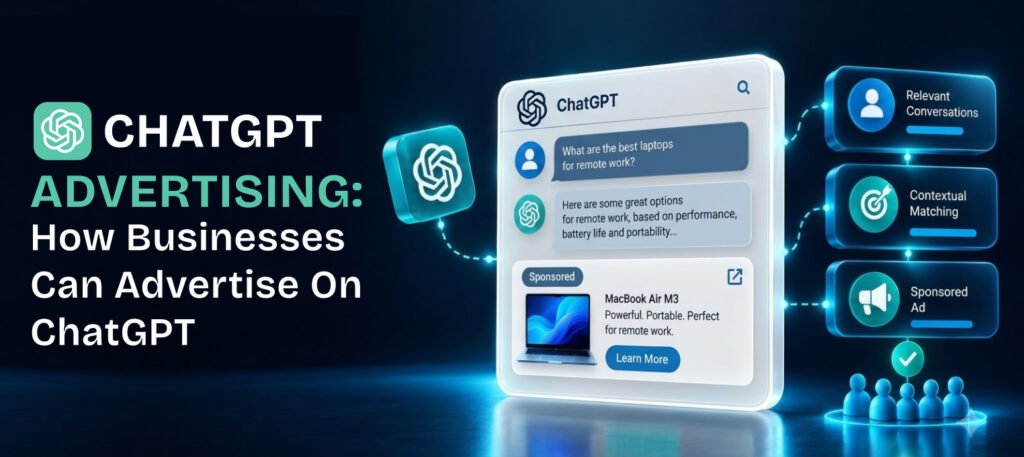
Quick overview: Have you observed ChatGPT advertising showing labeled, sponsored ads below ChatGPT answers through OpenAI’s Ads Manager? It’s matched to the conversation’s context and not to exact keywords. It is still in beta phase, billed by views or clicks, and open in a growing list of countries, so the smartest way in is a small, well-measured test.
ChatGPT has become a place where people do more than ask questions, since they use it to compare options, narrow choices and decide what to buy. That is exactly the moment many businesses want to be seen. OpenAI began testing ads in the US in February 2026, and its August 31 announcement says ChatGPT Ads reached a $1 billion annualized revenue run rate in less than 200 days and is now used by tens of thousands of advertisers. That growth explains why marketers are asking how advertising on ChatGPT works and whether it deserves a place in their budget.
Since it’s still in a developing channel with a beta ads manager, it is better treated as something to test than as a replacement for Google or Meta. This guide covers how the ads work, who can run them, how to set up a campaign, what it costs and how to measure results.
What Is ChatGPT Advertising and How Does It Work?
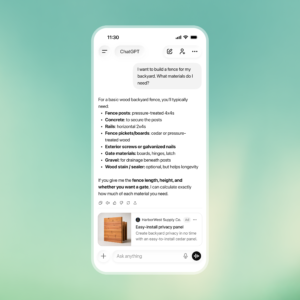
ChatGPT advertising means paying to show a clearly labeled sponsored ad below a ChatGPT answer when the conversation is relevant to what you sell. According to OpenAI’s Ads in ChatGPT basics, ads on ChatGPT appear below responses, and each one includes the advertiser name, a logo, a headline, a description, a landing page and an image. OpenAI also announced on October 5 that it will test a new visual format during image generation, which shows how quickly the formats are changing.
Matching works differently from search, because advertisers add context hints to an ad group instead of bidding on exact keywords. These hints describe the conversations, topics or needs where a product may be relevant, and OpenAI’s system weighs them alongside the conversation itself, the ad’s landing page, title and copy, and, when ads personalization is enabled, select signals from the user’s wider ChatGPT experience. The hints are not exact-match keywords and do not guarantee delivery, so advertising in ChatGPT rewards clear, specific descriptions of what you offer more than clever keyword lists.
Two distinctions are worth making early.
First, OpenAI says advertising does not influence the answers ChatGPT gives, so paying for ads cannot buy a recommendation inside an answer, and that keeps paid ads separate from organic visibility, which depends on your content and reputation.
Second, ChatGPT Ads is different from using ChatGPT to write ads for Google or Meta, since in that case ChatGPT is a writing tool, while here it is the place where the ad is shown.
Can Your Business Advertise on ChatGPT?
Most businesses in supported countries can, although access depends on your country, account verification and whether your ads follow OpenAI’s policies. Ads are shown to Free and Go users, but not to Plus, Pro, Business, Enterprise or Edu accounts or to accounts identified as belonging to people under 18, according to OpenAI’s ads FAQ, so your audience is a slice of ChatGPT’s users and not all of them.
On access, OpenAI says Ads Manager opened to small and medium-sized businesses in May, and its August 31 post says ads are now available in over 40 countries, with self-service launching across India, Europe, the Middle East and North Africa. Because this list keeps changing, check the current Ads Manager availability page before you plan anything. For account requirements, the quickstart guide lists a work-email OpenAI account, a billing profile and payment method, and account verification. Some new self-serve accounts may also advertise only in their home country until identity verification is approved and they reach a required spend, as OpenAI’s campaign setup guide explains.
Before planning a campaign, it also helps to confirm that your offer fits the Ads Policies, that your landing page is reachable, and that you can track what happens after the click.
How to Advertise on ChatGPT: A Step-by-Step Guide
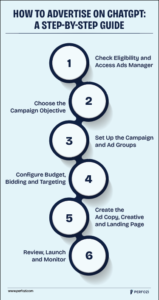
The process of how to advertise on ChatGPT follows three levels, which are the campaign, the ad group and the ad, and the six steps below follow OpenAI’s own documentation as of this writing.
Step 1: Check Eligibility and Access Ads Manager
Go to ads.openai.com, sign in with an OpenAI account tied to your work email, add your logo, set up billing, complete account verification and invite your team. ChatGPT Ads Manager is labeled Beta, so expect the interface to change, and if it isn’t open in your country yet, OpenAI says you can create an account and be notified when it is.
Step 2: Choose the Campaign Objective
Your objective decides how you are priced, and you cannot change it after creating the campaign. Choose Views to maximize visibility, Clicks to drive traffic to your site, or Conversions to optimize toward a supported conversion event, which only makes sense once your tracking is in place.
Step 3: Set Up the Campaign and Ad Groups
Organize ad groups around a shared product, service or customer need. OpenAI’s example is a plumbing business with separate groups for emergency repairs and preventive maintenance, since each speaks to a different need. Then add context hints that are specific, such as cushioned everyday running shoes for beginners training for a first 5K, which carries far more meaning than “running shoes.”
Step 4: Configure Budget, Bidding and Targeting
Choose a campaign-total or daily budget, set a maximum bid, pick the countries you want to reach and optionally narrow by platform, such as iOS app or desktop web. OpenAI suggests new advertisers start with a daily budget so they can watch delivery before committing more, and the next section covers the numbers.
Step 5: Create the Ad Copy, Creative and Landing Page
OpenAI advises clear, benefit-focused copy that says what you offer, who it helps and when it is useful, and it recommends several distinct variations per offering and not one message repeated. Link each ad to the most relevant page and not a generic homepage, add UTM tags to the URL and make sure the page doesn’t block OAI-AdsBot or OAI-SearchBot.
Step 6: Review, Launch and Monitor
Ads go live once they pass review, and if one is marked “Not serving,” hovering over the status shows why. One practical catch is that a first campaign may not show start and end date options before publishing, so if you need a specific start date, don’t publish just to reach those settings.
How Much Does ChatGPT Advertising Cost?
There is no fixed price, because cost depends on an auction and on the objective you choose. Views campaigns are billed per 1,000 impressions, Clicks campaigns per valid click, and Conversions campaigns bill per valid click or per 1,000 impressions, but never per conversion. OpenAI uses a relevance-weighted, second-price auction, so a higher bid alone does not win the placement.
You set a maximum bid at the ad group level, and for click campaigns OpenAI recommends starting at $3 to $5 per click, with Ads Manager sometimes showing bid-strength guidance. On a budget, a daily budget is an average of over seven days, daily spend can reach up to twice the amount you set, and the minimum daily budget depends on your billing currency, listed as 25 USD in OpenAI’s campaign table at the time of writing. Please recheck these figures before you commit, since this is a beta product.
Cost is also shaped by how relevant your ad, landing page and context hints are, how many advertisers compete for similar conversations, and your country and platform choices. A sensible way to plan is to start with a small daily budget and treat the first few weeks as a learning phase, without assuming any particular result.
How to Measure ChatGPT Advertising Performance
Ads Manager reports impressions, clicks, spend, click-through rate, average CPC, average CPM and conversions, but outcomes like qualified leads and revenue need tracking on your side. To measure conversions, you can set up conversion measurement in Ads Manager using OpenAI’s measurement documentation, and OpenAI’s August 31 post notes that its Pixel and Conversions API have become important foundations for measurement and optimization. You can also add static UTM parameters to landing page URLs so that traffic shows up in your existing analytics. One quirk to know is that impressions and clicks refresh about every 15 minutes, while spend can lag by seven to eight hours, so a zero in the spend column doesn’t always mean nothing was charged.
Clicks alone can mislead, so follow the visitors into your CRM or analytics and ask whether they became leads, customers or revenue. OpenAI has reported that an ecommerce advertiser achieved a 3x return on ad spend over 28 days and that a technology partner saw over 80% of ad-driven traffic come from new customers, but these are OpenAI-reported examples and not benchmarks you should expect. OpenAI’s October 5 post also says it is expanding measurement tools and partnerships, which suggests reporting will keep maturing.
Once you have data, use it to test new ad groups, sharper context hints and fresh creative variations, but give each change enough time and volume before you judge it.
ChatGPT Ads vs. Google Ads vs. Meta Ads
ChatGPT Ads reaches people while they research and decide inside a conversation, Google Ads reaches people typing a search, and Meta Ads reaches people browsing social feeds, so the right channel depends on your objective. Each one targets differently, since ChatGPT relies on conversation context and your hints, Google on keywords and search intent, and Meta on audience and interest signals.
Each also has trade-offs. Google and Meta are mature platforms with years of tools and benchmarks, while ChatGPT ads platform reporting and formats are younger and the audience is limited to Free and Go users. On the other hand, it offers access to a research behavior that is hard to reach elsewhere, and Google has also begun putting ads in AI Overviews and AI Mode, according to Axios, so conversational ads are not unique to one platform.
None of this proves that one channel will outperform another, so the practical approach is to keep your proven campaigns running and test ChatGPT with a small, separate budget, especially if your buyers research complex decisions in AI chats.
Common ChatGPT Advertising Mistakes to Avoid
The most common mistakes are launching without checking eligibility, treating context hints like exact keywords, sending traffic to a weak landing page, measuring clicks without conversions and judging results too early. Skipping the eligibility check leads to campaigns that stall on verification, billing or country limits, and it is easy to avoid by reading the requirements first. Treating context hints as exact-match keywords is a related trap, because they only guide relevance and do not guarantee delivery, so describing real needs in specific phrases works better than stuffing in short terms.
A generic landing page and clicks-only reporting then waste whatever traffic you do win, since people who don’t find what the ad promised leave, and you can’t tell which ad groups bring value. Finally, deciding after a few days with very little data is a common reason good tests get cancelled or bad ones get scaled.
If you’re weighing whether to test this alongside your existing paid media, our paid media team at Perfozi can help you work out how it fits your goals and how to measure it properly.
Frequently Asked Questions
-
Can I advertise on ChatGPT?
Yes, if Ads Manager is available in your country and your account and ads pass OpenAI’s verification and policy review.
-
How much does it cost to advertise on ChatGPT?
Cost depends on an auction and your objective, with OpenAI suggesting a starting maximum bid of $3 to $5 per click for click campaigns and listing a minimum daily budget that varies by currency.
-
How do you promote a business on ChatGPT?
You can pay for ads through Ads Manager, but you cannot buy a recommendation inside an answer, and organic visibility depends on your content and reputation.
-
How do you advertise on ChatGPT?
Create an Ads Manager account, build a campaign with ad groups and context hints, add your ads and landing pages, then launch and track the results.