Quick overview: Link building services help a website earn links from other relevant, trusted websites, and those links act as signals of authority that make its pages more competitive in search. Done well, SEO link building supports rankings and organic visibility, though it works best alongside strong content and technical SEO and can never guarantee a result on its own.
A website can have clean technical SEO and genuinely good content and still stall on page two, because search engines also look outward to see who else vouches for the site. That gap is exactly what link building services are meant to close. They help a business earn links from relevant, trusted websites, and those links pass authority and relevance signals that can make a page more competitive, which in turn can lift rankings and organic visibility. In short, SEO link building follows a simple chain where backlinks build authority, authority supports rankings, and rankings open the door to organic traffic. This guide explains how that chain works, what a good provider actually does, what it costs, and how to tell a strategic service from one that simply sells links.
What Are Link Building Services?
Link building services are SEO services where specialists research, pursue and earn backlinks to your website from other relevant sites, so that your pages gain authority in the eyes of search engines. Businesses usually outsource the parts that take the most time and skill, such as finding the right publishers, creating content worth linking to, running outreach and reporting on what the links achieve. That means a provider of SEO link building services, or a dedicated link building agency, should be responsible for the whole process from strategy to placement and not just for handing over a list of URLs.
This is also where earning links and “buying backlinks” part ways. Paying for links that pass ranking credit is exactly what Google’s spam policies describe as link spam, although the same policies accept paid links for advertising and sponsorship as long as they carry a rel=”nofollow” or rel=”sponsored” attribute. A professional service therefore focuses on earning placements through relevance, editorial value, and outreach, so the fee pays for expertise and effort rather than for ranking power.
How Do Link Building Services Help Improve Organic Rankings?
Link building services improve organic rankings by earning links from relevant, authoritative websites, which act as signals of trust and relevance that make your pages more competitive for the searches you want to win. The mechanism runs in a clear line, where relevant external links create authority and relevance signals. These signals strengthen a page’s competitiveness, and a more competitive page has greater ranking potential and more organic visibility. That line is the short answer to how does link building help SEO, and it explains why link building SEO still sits inside most serious search strategies.
Each part of that line does its own job. Authority comes from the fact that a link from a trusted website works like a recommendation, and relevance comes from the context around the link, which tells search engines what your page is about and who finds it useful. Links also help with discovery, since Google finds new pages largely by following links from pages it already knows, and Google’s Gary Illyes has pointed to natural inbound links as one way Google discovers new sites. Finally, when two pages answer a question equally well, the one backed by stronger and more relevant references often has the competitive edge.
Links do not guarantee rankings though, because search engines weigh many signals and a page with thin content or technical problems will not be rescued by backlinks alone. The strongest results come when a clear link building strategy is paired with useful content and a technically sound website, which is why link acquisition works best as one part of a wider SEO plan and not as a stand-alone fix.
What Makes a Backlink Valuable?
A valuable backlink comes from a website that is relevant to your topic, trusted in its field and read by a real audience, and it sits naturally inside useful editorial content. In other words, quality and relevance matter more than raw backlink volume, and that single idea separates quality backlinks from the “get hundreds of links” offers that fill most inboxes.
Several things decide whether a link is worth having.
- Topical relevance comes first, because a link from an industry publication tells search engines far more than a link from an unrelated directory.
- The authority of the referring site matters next, together with whether it has real organic traffic and a genuine readership.
- Placement and context count too, since a link woven into a helpful paragraph carries more weight than one tucked into a footer or a list of sponsors, and the anchor text should read the way a person would normally write it.
- The quality of the surrounding content also plays a part, because a link on a thin, spun-up page says little about your own site.
Together, these factors describe what authority link building aims for, which is a smaller number of references that actually mean something, and what natural link building looks like in practice, which is links that exist because a writer found your page genuinely worth citing.
What Do Link Building Services Actually Do?
A good provider researches your competitors, finds relevant opportunities, builds assets worth linking to, earns editorial placements through outreach and then reports on what those links achieve. Each step feeds the next, which is why the best link building services behave like a process and not like a product.
Research Competitors and Identify Link Gaps
The work starts by looking at which sites already link to your competitors but not to you, and then asking why. This reveals the publishers, topics and content types that already earn links in your space, and it gives the link building strategy a factual starting point, which a link building agency that skips this stage is simply guessing without.
Find Relevant Link Opportunities
From there, the team builds a shortlist of websites that fit your topic and audience, checking their traffic, their editorial standards and whether they link out to businesses like yours. A short list of strong fits beats a long list of weak ones.
Create or Improve Linkable Assets
Few sites link to a plain service page, so a provider often improves or creates something people want to reference, such as original research, a useful guide, a calculator or a well-explained industry resource.
Conduct Outreach and Earn Editorial Placements
Next comes personalized outreach to editors and site owners, explaining why your page adds value to what they already publish. Placements are earned when the pitch matches a real need, which is what makes the resulting link look natural to both readers and search engines.
Monitor and Report Results
Finally, a provider tracks which links were won, how the target pages move in rankings and visibility, and what that means for traffic and leads, so the next round of SEO link building builds on evidence and not on assumptions.
At Perfozi, link acquisition is treated as part of the wider SEO strategy, alongside content, technical SEO and authority-building efforts, since links work best when the pages they point to are already worth visiting. You can see how these pieces fit together in our SEO services.
Which Link Building Strategies Can Services Use?
Services typically combine digital PR, content-led link building, manual outreach, contextual placements and link reclamation, and they choose the mix according to your industry, goals and budget. Some brands lean on outsourced link building because they lack in-house outreach time, and some agencies offer white label link building, where the work is delivered under another agency’s name.
Digital PR and Earned Media
Digital PR earns links by creating newsworthy stories, data or commentary that journalists and publishers want to cover, which tends to produce high-authority links but takes real creative effort.
Content-Led Link Building
Here, a valuable resource such as a study, guide, or tool attracts links over time because other writers find it useful to cite.
Manual Outreach
Manual outreach means contacting relevant site owners directly to suggest a resource or contribution, and it works best when each pitch is tailored to the site instead of sent in bulk.
Contextual Placements
These are links placed inside relevant articles on other sites, where they need to be genuinely helpful and follow Google’s rules on paid or sponsored links.
Link Reclamation
Reclamation recovers links you should already have, such as unlinked brand mentions or links lost when a page moved, and it is often one of the cheapest wins available.
Can Link Building Improve Organic Traffic, Not Just Rankings?
Yes, link building can improve organic traffic when the links point to the right pages, because stronger rankings lead to more visibility, more clicks and, over time, more leads or sales. The path runs from links to authority, from authority to rankings, from rankings to visibility and from visibility to clicks, so each link is only useful if it moves that chain forward.
Still, rankings are not the final KPI and neither is the number of links. The better question is whether the right pages became more competitive and produced results that matter to the business, such as qualified visits or enquiries. That is why link building SEO should be judged by outcomes, and why a handful of quality backlinks to a high-intent page can outperform dozens of links to pages nobody needs. It is also the honest answer to whether backlinks improve rankings, since they can help when the page, the content and the links all line up. Perfozi evaluates SEO performance through visibility and business outcomes rather than simply counting backlinks.
Suggested Readings: How We Earned 142 Editorial Links From One Data Study: A Digital PR Playbook
How Much Do Link Building Services Cost?
The cost of link building services varies widely, but published price guides show managed campaigns commonly starting around $3,000 a month and passing $10,000, while a 2026 survey of 518 SEOs found that about $509 was the average price seen as acceptable for one high-quality link. These are vendor and survey figures, so treat them as a guide to the range and not as a quote.
A single price per backlink would be misleading, because several factors shape link building costs. Publisher quality and relevance move the price most, since trusted, on-topic sites are harder to earn, and industry difficulty matters too, with competitive niches such as finance and legal pricing well above average. Content requirements add to the total as well, because a link that needs original research costs more than one earned through a quick outreach email, and digital PR typically costs more than traditional outreach because of the creative work behind it. Campaign scale and outreach effort complete the picture, so the better question to ask is what each approach is expected to deliver for the money and how that will be measured.
How to Evaluate a Link Building Service
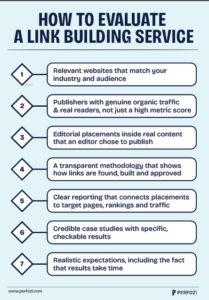
The best way to evaluate a link building service is to judge its method and its results and not the number of links it promises. A trustworthy provider should be able to explain how it finds sites, what kinds of placements it earns and how it will report on progress, and it should be comfortable being asked.
Here is what to look for when comparing link building services or a link building agency:
- Relevant websites that match your industry and audience
- Publishers with genuine organic traffic and real readers, not just a high metric score
- Editorial placements inside real content that an editor chose to publish
- A transparent methodology that shows how links are found, built and approved
- Clear reporting that connects placements to target pages, rankings and traffic
- Credible case studies with specific, checkable results
- Realistic expectations, including the fact that results take time
Be wary of anyone who guarantees rankings or relies on link farms and PBN-style networks, since Google’s SpamBrain system is built to neutralize unnatural links and detect sites buying them, which means those links can end up worth nothing or worse.
The right question is therefore not “how many links will I get?” but “what strategy will produce the right links, and how will we know they’re creating value?” That is the thinking behind our SEO link building services at Perfozi, where strategy, specialist execution and accountability work together so you can see how each link connects to rankings and business results.
Link Building for SEO and AI Search
Link building still matters for traditional SEO because authority signals still help pages compete, and credible editorial mentions are becoming part of the wider visibility conversation as AI-generated answers appear in search results. That does not mean backlinks guarantee a citation in an AI Overview, and nobody should promise that they do. What it does mean is that authority link building, which earns references from trusted websites in your field, supports both goals, because being cited by credible sources builds the reputation that people and search engines both look for. Natural link building fits this well, since links earned through genuinely useful content hold up whichever way search keeps changing. You can read more in our guide to optimizing content for AI search and discovery.