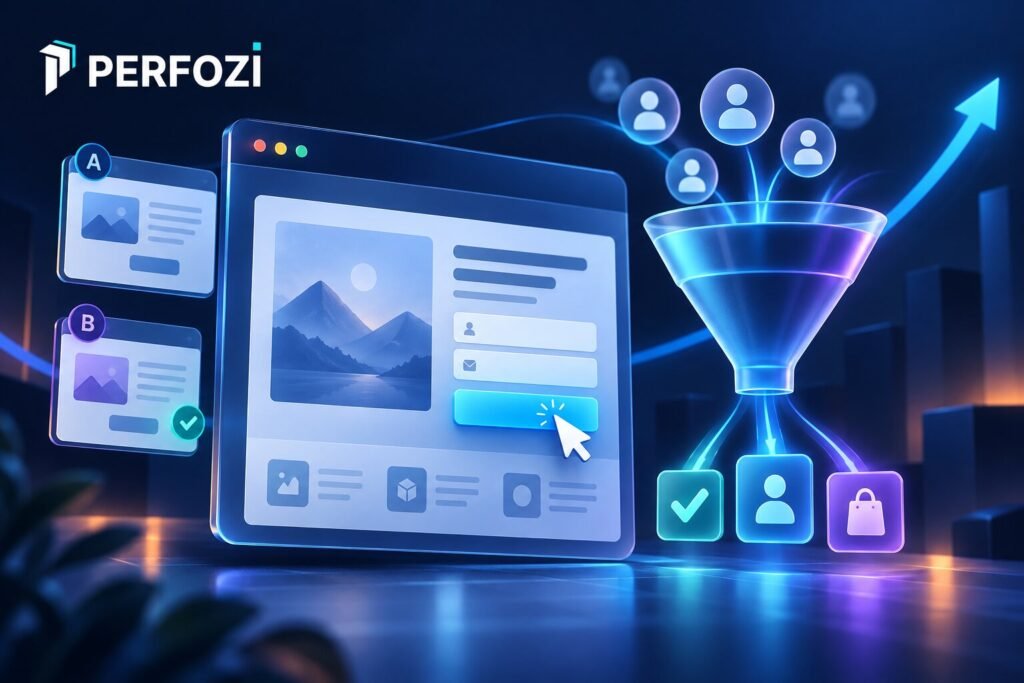
Conversion Rate Optimization, commonly known as CRO, helps businesses turn more of their existing visitors into customers. It involves studying user behavior, identifying barriers, improving important pages, and testing changes based on evidence.
Businesses often invest in SEO services, advertising, social media, and content creation to increase traffic. CRO helps produce more value from those investments by making it easier for qualified visitors to take the next step.
What Is Conversion Rate Optimization?
Conversion Rate Optimization is the process of improving a website or landing page so that a higher percentage of visitors complete a desired action.
A conversion can include:
- Purchasing a product
- Requesting a quote
- Booking an appointment
- Completing a contact form
- Registering for an account
- Starting a free trial
- Downloading a guide
- Subscribing to an email list
- Calling the business
- Adding a product to the cart
The desired action depends on the website and its business model. An ecommerce store may prioritize completed purchases, while a digital media agency may focus on consultation requests and qualified leads.
CRO is not about manipulating users. It is about removing uncertainty, reducing unnecessary effort, and helping people make informed decisions.
How to Calculate Conversion Rate
The basic conversion rate formula is:
Conversion Rate = (Number of Conversions ÷ Number of Visitors) × 100
For example, if a landing page receives 2,000 visitors and generates 80 enquiries:
(80 ÷ 2,000) × 100 = 4% conversion rate
The same formula can measure purchases, registrations, downloads, or other actions.
However, the overall conversion rate does not explain everything. Businesses should also review conversions by:
- Traffic source
- Device
- Landing page
- Location
- New and returning visitors
- Product category
- Campaign
- Customer segment
A page may perform well on desktop but lose mobile visitors because of a difficult form or slow loading time. Segmenting the data helps reveal where the real problem exists.
Why Conversion Rate Optimization Matters
Increasing traffic usually requires additional time, content, or advertising budget. CRO can improve results from the traffic a business already has.
A stronger conversion experience can lead to:
- More sales and enquiries
- Lower customer acquisition costs
- Better advertising returns
- Greater value from organic traffic
- Improved customer experience
- More useful website data
- Reduced cart and form abandonment
- Stronger marketing performance
Suppose an online store receives 20,000 monthly visitors and converts 1% of them. That produces 200 orders. Increasing the conversion rate to 1.5% would generate 300 orders from the same traffic.
A performance marketing company should therefore consider both traffic acquisition and conversion performance. Sending more people to a confusing page simply increases the number of visitors who leave.
CRO and SEO Should Work Together
SEO attracts relevant users from search engines, while CRO helps those users complete valuable actions.
The two strategies should support each other.
A search engine optimization company may improve rankings for a high-intent service keyword, but the landing page must still provide:
- A clear service explanation
- Relevant proof
- Easy navigation
- A visible call to action
- Transparent contact information
- A simple enquiry process
Aggressive conversion tactics can damage the user experience. Excessive pop-ups, misleading buttons, hidden charges, and forced registrations may increase a short-term metric but reduce trust.
Good SEO services for businesses bring the right audience to the website. Good CRO makes it easier for that audience to move forward.
1. Define the Right Conversion Goals
Before changing a website, decide which actions matter to the business.
Separate goals into two categories:
Primary conversions
These actions directly support revenue or customer acquisition:
- Completed purchase
- Quote request
- Consultation booking
- Paid subscription
- Product demo request
Micro-conversions
These actions indicate progress toward the main goal:
- Viewing a pricing page
- Adding a product to the cart
- Watching a product demonstration
- Downloading a resource
- Signing up for emails
- Starting a form
Micro-conversions help identify where users lose interest. If many people begin the checkout process but few complete payment, the issue is probably not product demand. The checkout experience requires attention.
2. Understand User Intent
Every visitor arrives with a purpose. The landing page should match that purpose.
Someone searching “what is local SEO?” probably needs educational information. A visitor searching “hire local SEO expert” is more likely to be comparing providers.
These users should not receive the same page experience.
Match content with different levels of intent:
- Informational: Guides, definitions, checklists and tutorials
- Comparison: Service comparisons, case studies and pricing factors
- Commercial: Product and service pages
- Transactional: Booking, checkout and registration pages
An experienced SEO specialist can identify search intent, while CRO analysis determines whether the page satisfies it effectively.
3. Create a Clear Value Proposition
Visitors should understand what the business offers, who it serves, and why the offer matters within a few seconds.
A weak value proposition might say:
Innovative strategies for modern business growth.
A clearer version would say:
SEO, content, and paid advertising services that help growing businesses generate qualified leads.
The second statement explains the services, audience, and intended outcome.
Place the primary value proposition in a prominent position. Support it with a concise explanation and a relevant call to action.
Avoid complicated language and unsupported claims such as “best in the industry” or “guaranteed success.”
4. Simplify Website Navigation
Complicated navigation creates hesitation. Visitors should be able to find important information without opening several menus or guessing where a page is located.
Keep the main navigation focused on essential sections such as:
- Services
- Products
- Pricing
- Case studies
- Resources
- About
- Contact
A company providing multiple solutions can organize them into clear groups. For example, content marketing services, PPC management services, and social media management services may appear under a main Services menu.
Review navigation on mobile devices as well as desktop screens. A menu that works on a large display may become difficult to use on a phone.
5. Improve Calls to Action
A call to action tells the visitor what to do next. It should be specific, relevant, and easy to find.
Useful examples include:
- Request a free consultation
- Get a custom proposal
- Compare service packages
- Start your free trial
- Add to cart
- Book an appointment
- Download the guide
- Check availability
Avoid relying entirely on vague labels such as “Submit” or “Click Here.”
The call to action should also match the visitor’s level of commitment. Someone reading a beginner’s guide may be more comfortable downloading a checklist than booking a sales call immediately.
Use one clear primary action per section. Too many competing buttons can make the decision more difficult.
6. Reduce Form Friction
Forms are a common conversion barrier. Every additional field creates another reason for someone to stop.
Ask only for information that is necessary at that stage. An initial consultation form may require:
- Name
- Business email
- Company
- Service needed
- Short message
It probably does not need a complete address, detailed revenue information, or several drop-down questions before the first conversation.
Improve form completion by:
- Using clear field labels
- Showing helpful error messages
- Supporting autofill
- Making fields mobile-friendly
- Explaining why sensitive information is required
- Showing confirmation after submission
- Avoiding unnecessary account creation
If a field repeatedly causes abandonment, consider removing it or asking for the information later.
7. Build Trust Near Conversion Points
Visitors often hesitate because they are uncertain about quality, security, price, or what will happen next.
Place relevant trust signals near forms, checkout buttons, and service calls to action.
These may include:
- Genuine customer reviews
- Detailed case studies
- Secure payment information
- Return and refund policies
- Professional qualifications
- Clear contact details
- Delivery information
- Privacy explanations
- Service guarantees with clear conditions
- Recognized certifications
A branding services company can create a consistent visual identity, but design alone does not establish trust. Claims must be supported by transparent information and real evidence.
8. Improve Landing Page Relevance
An advertising campaign should send visitors to a page that closely matches the ad.
If an ad promotes Google Ads management, it should lead to a page explaining that service—not a general homepage listing every marketing solution.
A relevant landing page should include:
- A headline matching the user’s goal
- A direct explanation of the offer
- Key benefits
- Process or deliverables
- Supporting proof
- Frequently asked questions
- A focused call to action
This is especially important for pay per click advertising, where irrelevant landing pages waste advertising spend and reduce conversions.
A professional PPC agency should review the full journey from keyword and ad copy to landing page and follow-up.
9. Improve Page Speed and Mobile Usability
Slow pages interrupt the conversion journey. Visitors may leave before seeing the product, service, or form.
Common performance problems include:
- Oversized images
- Unnecessary scripts
- Heavy page builders
- Too many tracking tools
- Poor-quality hosting
- Auto-playing videos
- Complicated animations
Mobile visitors also need buttons that are easy to tap, readable text, short forms, and a checkout process designed for smaller screens.
Technical improvements may not feel as creative as changing a headline, but they can have a major effect on user experience and conversion performance.
10. Use Helpful Content to Reduce Doubt
Visitors do not always convert because they need more information, not because they lack interest.
Useful supporting content can answer questions about:
- Pricing
- Timelines
- Features
- Product compatibility
- Service deliverables
- Return policies
- Implementation
- Expected outcomes
- Alternatives
- Common risks
A strong content marketing strategy connects educational content with commercial pages. Blog articles, comparison guides, videos, case studies, and FAQs can move visitors closer to a confident decision.
A content marketing agency should understand where each asset fits within the customer journey instead of publishing articles only to increase traffic.
11. Use Social Proof Carefully
Social proof helps people feel more confident when they see that others have had a positive experience.
Useful forms include:
- Customer testimonials
- Verified product reviews
- Case studies
- Client logos
- Usage statistics
- Video feedback
- Before-and-after examples
Use specific proof whenever possible. “Excellent service” provides limited information. A testimonial explaining the client’s problem, experience, and outcome is more useful.
Do not publish fake reviews or unsupported results. Misleading proof may increase short-term attention but can seriously damage trust.
12. Test One Clear Hypothesis at a Time
A/B testing compares two versions of a page element to determine which performs better.
Elements worth testing may include:
- Headlines
- Calls to action
- Form length
- Product images
- Page layout
- Pricing presentation
- Trust signals
- Checkout steps
- Offer wording
- Navigation
Every test should begin with a hypothesis.
For example:
Reducing the consultation form from eight fields to five will increase completed enquiries because users currently abandon the longer form.
Changing several unrelated elements at the same time makes it difficult to understand what influenced the result.
A test should also run long enough to collect meaningful data. Decisions based on a small number of visitors may be misleading.
13. Use Heatmaps and Session Recordings
Analytics can show where users leave, but behavioral tools can help explain why.
Heatmaps can reveal:
- Where visitors click
- How far they scroll
- Which elements attract attention
- Whether users click non-clickable objects
Session recordings may show:
- Repeated clicking
- Form errors
- Navigation confusion
- Mobile usability problems
- Abandoned checkout steps
These tools should be configured with appropriate privacy protection. Sensitive personal and payment information must not be recorded.
Use behavioral data to develop test ideas rather than treating every recorded action as a universal pattern.
14. Optimize Ecommerce Product Pages
Product-page CRO should help shoppers understand the item and purchase it confidently.
Important elements include:
- Specific product title
- Clear product images
- Complete specifications
- Price and availability
- Size or variation options
- Shipping information
- Return policy
- Customer reviews
- Product FAQs
- Visible Add to Cart button
Do not reveal unexpected delivery charges only at the final checkout stage. Customers should understand the likely total cost before committing.
Product recommendations can increase order value, but they should not interrupt the primary purchase. Relevant accessories and complementary products work better than unrelated suggestions.
15. Reduce Cart and Checkout Abandonment
A shopper who reaches the cart has already shown strong interest. Avoid making the final steps unnecessarily difficult.
Improve checkout by:
- Allowing guest checkout
- Showing all costs early
- Reducing the number of steps
- Supporting familiar payment methods
- Saving cart contents
- Displaying delivery estimates
- Making discount-code fields less distracting
- Providing clear error messages
- Showing order confirmation
Cart-recovery emails can remind customers about unfinished purchases, but they should not replace improvements to the checkout itself.
An email marketing agency can support recovery campaigns while the website team addresses the underlying causes of abandonment.
16. Connect CRO With Paid Media
Paid campaigns provide valuable conversion data. They show which offers, messages, products, and audiences respond most strongly.
A Google Ads agency can use CRO insights to improve:
- Ad-to-page relevance
- Landing-page messaging
- Lead quality
- Cost per conversion
- Return on ad spend
A social media ad agency may test different benefits, visuals, and audience segments. Winning messages can then inform organic content and website copy.
CRO should connect the work of the paid search agency, creative team, SEO team, and developers. A campaign cannot reach its full potential if each team optimizes a different part of the journey without sharing information.
17. Measure Lead Quality, Not Just Quantity
More conversions do not always mean better business results.
A shorter form may produce more leads but also attract people who are not suitable customers. A promotional discount may increase orders while reducing profit.
Track downstream outcomes such as:
- Qualified leads
- Sales appointments
- Proposal acceptance
- Average order value
- Customer acquisition cost
- Refund rate
- Customer lifetime value
- Revenue per visitor
A performance marketing company should connect website conversions to revenue and customer quality rather than reporting form submissions alone.
Common Conversion Rate Optimization Mistakes
Avoid these common CRO problems:
- Testing without enough traffic
- Copying a competitor’s website
- Changing several elements at once
- Measuring only button clicks
- Ignoring mobile visitors
- Using misleading urgency
- Adding too many pop-ups
- Asking for unnecessary information
- Hiding fees until checkout
- Removing important content to shorten a page
- Optimizing for conversions without checking lead quality
- Ending tests as soon as one version moves ahead
CRO is not a collection of random design changes. It is a continuous process built around research, evidence, and measurable business goals.
A Practical CRO Process
Use this repeatable process to improve conversion performance:
- Define the primary conversion.
- Confirm that tracking works correctly.
- Segment performance by page, source, and device.
- Identify the largest conversion drop-off.
- Review customer feedback and behavior.
- Create a specific hypothesis.
- Prioritize the change by impact and effort.
- Run an appropriate test.
- Measure conversion quality.
- Document the result.
- Apply the learning to relevant pages.
- Continue monitoring performance.
This approach prevents businesses from making decisions based only on personal preferences.
When Should You Hire a CRO or Marketing Expert?
You may need to hire a marketing expert when your website receives relevant traffic but generates inconsistent sales or enquiries.
Professional assistance may also be helpful when:
- Paid traffic is expensive but produces few conversions
- Customers frequently abandon forms or carts
- Landing pages have high bounce rates
- Conversion tracking is unreliable
- Mobile performance is weak
- The team lacks testing experience
- Leads are increasing but quality is declining
Businesses may choose to hire an SEO expert, hire a PPC specialist, or work with a full-service digital marketing agency in USA, depending on where the problem occurs.
The provider should examine the complete customer journey rather than suggesting cosmetic changes without research.
Final Thoughts
Mastering Conversion Rate Optimization does not require redesigning the entire website every few months. It requires understanding what visitors need, identifying what prevents them from acting, and improving the experience through evidence.
Begin with clear goals and reliable data. Strengthen the value proposition, simplify navigation, reduce form friction, improve mobile usability, and place trust signals where uncertainty is highest. Then test changes carefully and measure their effect on both conversion volume and customer quality.
Traffic creates opportunity, but a clear and trustworthy experience turns that opportunity into meaningful business growth.
Frequently Asked Questions
What is a good conversion rate?
There is no universal benchmark. A good conversion rate depends on the industry, traffic source, offer, price, device, and conversion type. Compare performance against your own historical data and business goals.
What is the difference between CRO and SEO?
SEO helps attract relevant organic visitors, while CRO helps more visitors complete valuable actions. The two strategies work best when search intent, page content, and conversion experience are aligned.
How long does CRO take to produce results?
Simple usability improvements may produce quick results. Reliable testing generally requires enough traffic and conversions to reach a meaningful conclusion. Lower-traffic websites may need longer test periods.
Does CRO require A/B testing?
Not always. Businesses can begin by fixing clear usability problems, broken forms, slow pages, inaccurate information, or confusing navigation. A/B testing is most useful when more than one reasonable solution exists.
Can CRO reduce advertising costs?
CRO may reduce cost per conversion by generating more results from the same amount of paid traffic. It cannot compensate for poor targeting, an unsuitable offer, or irrelevant advertising.
Which pages should be optimized first?
Start with high-traffic and high-intent pages, such as product pages, service pages, pricing pages, landing pages, forms, carts, and checkout pages.
Can a small business use CRO?
Yes. Small businesses can improve results by simplifying forms, clarifying calls to action, improving mobile usability, publishing transparent information, and speaking directly with customers about their concerns.
What CRO tools are commonly used?
Businesses often use web analytics, form analytics, heatmaps, session recordings, customer surveys, user testing, and A/B testing platforms. The right tools depend on traffic levels, goals, and privacy requirements.
Should I hire a CRO specialist or an SEO agency?
Hire according to the main problem. An SEO agency is suitable when traffic and search visibility need improvement. A CRO specialist is more appropriate when the website already receives qualified traffic but struggles to convert it. Some agencies provide both services.