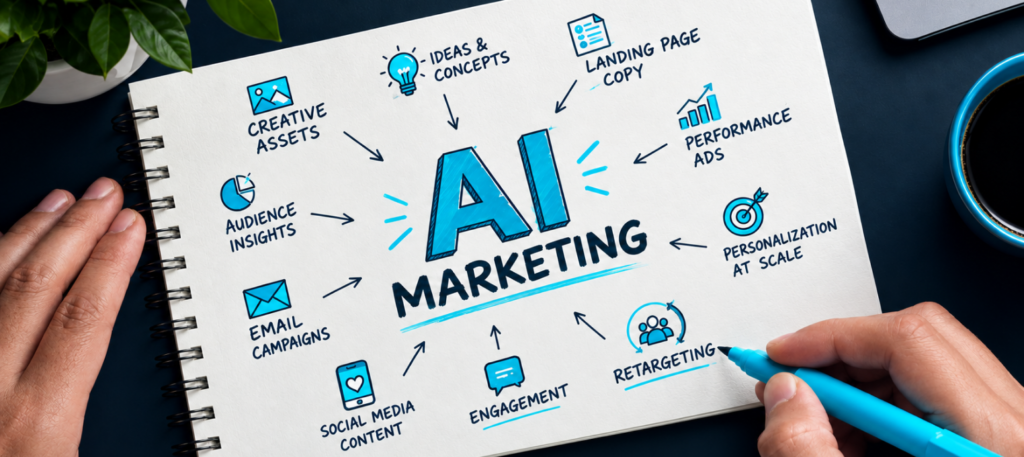
Quick overview: AI generated marketing content is any copy, image, video, ad, or email that AI helps create for marketing goals. Brands use AI to produce more variations in less time, personalize messages for different audiences and test ideas in days instead of weeks. Speed alone does not make marketing work though, so results still depend on strategy, brand judgment and human review. This guide covers what AI can create, examples of AI in marketing from real brands, how AI creative generation is changing ads, and an eight-step process for using it well.
With AI, publishing online has never been easier and that is exactly where the trouble starts, because a small team can now draft a blog post, create ten ad variations, and a week of social posts before lunch. Yet, more content does not automatically mean better marketing. Nowadays, plenty of brands are shipping faster with AI marketing content and still seeing flat results, either because their output sounds like everyone else’s or because nobody checked whether it matched what the audience wanted.
AI can speed up production across marketing, but strategy, positioning, creativity and human judgment still decide whether that content works. With that in mind, this guide explains how AI-generated marketing content works in practice, where it delivers and where it falls short, using real brand results instead of hype.
What Is AI-Generated Marketing Content?
AI-generated marketing content is any marketing asset that generative AI creates, such as written copy, images, videos, ad creatives, emails and campaign variations. It works because generative AI in marketing learns patterns from huge amounts of existing content and then produces new text, visuals or audio from a prompt, so a short brief can become a full first draft in seconds, which is what makes AI content creation so appealing to busy teams.
That also explains how it differs from older marketing automation, since automation mostly schedules and sends what humans already made, whereas AI generated content for marketing produces the first version of the asset itself, from blog posts and product descriptions to social posts and landing page copy. IBM takes an even wider view by describing AI marketing as the use of data analysis, machine learning and natural language processing to deliver customer insights and automate decisions, so content creation is only one piece of a bigger picture.
What Can AI Create for Marketing?
AI can create written, visual, video and personalized marketing content, and the useful question for each type is not “can it do this” but “which part of the job should it do.” Because AI generated content in marketing now covers so many formats, it helps to know where it is used most, and HubSpot’s 2025 State of AI Marketing Report found that 51% of marketers use AI for emails and newsletters, 49% for text-based social content, 47% for social video and audio, and 46% for long-form content like blogs, which shows that AI content marketing already goes well beyond simple blog drafts.
Written Marketing Content
AI is strongest at writing because it can turn a short brief and a few examples into a usable first draft, which is why teams use it for blog posts, social posts, email copy, ad copy, product descriptions and website copy. The best results come when a person supplies the raw thinking, meaning the opinions, data and customer stories, and lets the AI handle structure, phrasing and polish. Authority Hackers works this way, since its founder feeds an AI his rough notes and past newsletters and then edits the output by hand, which cuts his weekly newsletter time roughly in half, according to Ahrefs’ roundup of AI marketing examples. If you want that kind of writing support alongside strategy, Perfozi’s content marketing services are a natural fit.
Visual Marketing Content
AI can produce social graphics, product imagery, ad creatives, and campaign visuals, and this is where the AI creative generation saves the most money on photoshoots. It works best for things that do not exist yet or cost a lot to shoot, such as concept art, backgrounds and pre-launch visuals, while the real product usually still needs real photography, because AI tends to struggle with exact product details. Even then, raw output rarely ships as it is, so it makes sense to plan for a designer to clean up and check the results, which is exactly the way our specialists are trained to be accountable for.
Video Marketing Content
AI can make short-form videos, product videos, explainers, UGC-style clips and many versions of the same video, and the biggest gain is speed. A common approach is to build the video in layers, generating images or characters first, animating them next and adding human-recorded voice or lines last, so the emotional parts stay human while the slow parts get automated. The tradeoff is that AI video can still look artificial in places, which means the style you choose matters as much as the tool. This requires specialists, experienced with using AI, as well as editing videos for reputed clients.
Personalized Marketing Content
AI can write different messages for different audiences, offers and funnel stages at a scale no team can match by hand, and AI personalization is often where the payoff is clearest. Zomato shows how far this can go, since it used voice cloning and AI lip-syncing to turn a handful of celebrity ads into millions of versions that named local restaurants and dishes, each shown to people in their own area and language, as Salesforce’s AI marketing guide describes. Most brands will never need that scale, but the same idea works on a smaller level, such as sending one email to a new lead and a different one to a returning customer.
This is how AI can be leveraged for your business, to create bulk content without compromising on the personalized brand style.
7 Examples of AI in Marketing (With Real Brand Results)
The seven most common AI in marketing examples are blog and SEO content, social content, ad creatives, campaign variations, email, repurposing and workflow automation, and each one works best when AI does the heavy lifting while a person keeps control of the message. Together they work as AI generated marketing content examples and examples of AI in digital marketing that you can start on this month. Let’s start with the brief examples below, while Mailmodo’s guide has many more if you want to keep reading.
- Blog and SEO content. AI helps most before and after the writing, meaning research, outlines, topic gaps and tightening drafts, so the human keeps the angle and the fact-checking. A good habit is to use it to see what top-ranking pages already cover and then add something they do not, such as your own data or experience, which pairs well with a proper SEO strategy. Many SEO agencies today manage to rank their blogs while using AI to create bulk drafts by humanizing the strategy and automating the creation process.
- Social media content. AI is good at turning one idea into many posts and at reacting quickly to trends. Popeyes showed this in July 2025, when it had an AI studio produce a parody rap video about three days after McDonald’s relaunched its Snack Wrap, and per Ahrefs it passed 10 million views on roughly $200 in monthly AI tool subscriptions. Speed beat polish in that case, so social media marketing teams can use AI for the moments where timing matters most.
- Ad creatives. AI can produce fresh images, angles and headlines quickly, but the AI generated ad creatives must match what customers will really get. A dog harness brand learned this when AI images of dogs wearing its harness doubled daily orders and revenue, yet some customers felt misled because the images looked better than the real product, so the brand redesigned the harness to match, according to Ahrefs.
- Campaign variations. AI can turn one brief into dozens of versions for different audiences, which is what lets AI marketing campaigns test far more ideas than a manual setup. The value comes from testing those versions, so the next section on AI creative generation shows how.
- Email marketing. AI helps write subject lines and body copy and then adapts them to segments such as new leads, repeat buyers or people who abandoned a cart, so each group hears something that fits. It is best to start with one automated sequence and test two versions before scaling, and to connect it to your email marketing setup.
- Repurposing existing content. AI can turn a long video, webinar or article into clips, posts, summaries and translations, which gives your best ideas more reach without starting from scratch. Expect to discard a fair share of the results, since the goal is to pick the good ones instead of publishing everything.
- Automating repetitive workflows. AI marketing automation handles steps such as sorting, flagging and formatting, and a team at Ahrefs, for example, built workflows that check Google Ads search terms and flag whether they are relevant, which removes a tedious manual review and frees time for strategy.
AI Creative Generation: How AI Is Changing Ad Creatives
AI creative generation is changing ads by letting teams test many versions instead of guessing at one, through a loop of brief, generate, test, learn and repeat, and the value comes from that loop and not from generation alone, since a hundred untested ads are just noise. That is why AI in advertising is really about learning faster, and the AI advertising examples below show what that looks like at each step.
AI-Generated Ad Copy
AI-generated ad copy works best when you give it a clear brief and test it against your current copy instead of replacing it outright. Very Ireland did exactly that by rewriting 1,471 product titles with AI and running them side by side with manual titles, and the AI titles started 3% worse in the first month but finished 11% better on click-through rate by month four, as Ahrefs reports from Wolfgang Digital’s case study. The early dip is the useful part, because it shows that a test may need months to pull ahead, so judge it slowly, and if you run paid search the same idea applies to headlines and descriptions.
AI-Generated Images and Visuals
AI-generated ad images work well for concepts, backgrounds and pre-launch visuals, provided they never promise more than the product delivers, as the dog harness example showed. A simple check is to put the AI image next to the real product and ask whether a customer would feel fooled, and if the answer is yes, the image needs to change. Packaging is another strong use, and clear branding and packaging direction helps keep those visuals on brand.
AI-Generated Video Ads
AI generated ads in video form suit entertainment-first, time-sensitive campaigns, and they work best when the style plays to what the tools do well. Playful or surreal looks tend to land better than attempts to fake realistic footage, since Ahrefs points out that brands face backlash when AI content pretends to be real, which is why the Popeyes video leaned into the absurd instead of hiding it.
Creating Multiple Creative Variations
Creating multiple variations is where AI saves the most effort, because one brief can become dozens of headlines, images or hooks, and each AI ad creative can be matched to a different audience. The catch is that more variations only help when they differ in a meaningful way, so change one thing at a time, such as the hook, the image or the offer, and you will learn which change made the difference.
Testing and Learning From Performance
Testing turns AI output into knowledge, so every variation should be tracked against one clear goal such as click-through rate, cost per lead or conversion rate. Barilla’s 15-day Meta campaign shows the payoff, because an AI tool wrote copy for different audience segments and moved budget toward the winners automatically, which produced a 6.58% click-through rate and cut cost per click by 81%, according to a Buzzly case study that Ahrefs summarizes. Since that study comes from the tool’s own vendor, treat the numbers as a strong signal instead of a guarantee, and take the habit behind them, which is to test several versions and shift spend toward the winners, into any campaign you run.
How Businesses Are Using AI Across the Marketing Funnel
AI supports every stage of the marketing funnel, though the job it does changes at each stage.
| Funnel stage | What AI does | Example from this guide |
|---|---|---|
| Awareness | Social content, videos and ad creatives that catch attention | Popeyes’ rap video |
| Consideration | Educational content, email sequences and personalization | FARFETCH email copy testing |
| Conversion | Ad variations, landing page content and stronger CTAs | Barilla and Very Ireland tests |
| Retention | Personalized emails and customer content | HubSpot’s behavior-based email personalization |
| Advocacy | Repurposed content and community or user-created content | Coca-Cola’s artist platform |
Behind the scenes, AI marketing automation ties these pieces together by triggering the right version at the right moment, for example by sending a different email based on what a lead just clicked, and that is what turns separate tools into a working system.
What Are the Benefits of AI-Generated Marketing Content?
The main benefits are speed, variety, and scale, as long as a human keeps quality in check and HubSpot’s survey found that 55% of marketers name time savings as their key reason for using AI. Faster production comes first, since first drafts, images and clips now arrive in minutes, and that speed makes it easy to test more creative variations from a single brief. Personalization gets easier too though this requires initial training and this is the most important element of generating creatives using AI because messages can fit different segments and funnel stages, while a detailed brand prompt helps keep tone steady across channels. Repurposing long videos and articles into clips and posts becomes simpler as well, and since results arrive sooner, experiments run faster and small teams can handle more work without adding headcount. The complete output depends on the effort inverted at the time of setup and training the model.
What Are the Limitations of AI-Generated Marketing Content?
The biggest limits are accuracy, sameness and a lack of original insight, and all three need human review to fix. In HubSpot’s survey, 43% of marketers said AI sometimes produces inaccurate information, 34% said it can be biased and 30% said its content can be vague or surface-level, and beyond those concerns the output can drift from your brand voice, repeat what competitors already say and turn samey when everyone publishes AI generated content from similar prompts and tools.
Over-reliance is a risk as well, because Ahrefs notes that the well-known AI marketing failures, such as fake influencers and robotic copy, happened when brands treated AI as a replacement for strategy and authenticity. The practical fix is to keep a human reviewer on every asset and fact-check every claim, while adding what AI cannot supply on its own, such as original data, customer stories and real product experience.
AI + Human Creativity: What Should Each Do?
AI should handle volume and pattern work, while humans should own strategy, judgment and original ideas, and the split is easiest to see side by side.
AI is good at generating variations, summarizing, repurposing, spotting patterns, writing first drafts and scaling production.
Humans are still needed for strategy, positioning, brand judgment, original ideas, audience understanding, fact-checking and final creative direction.
Single Grain’s Eric Siu is a good illustration, since AI cut his video brainstorming from hours to about an hour by analyzing successful content and suggesting alternatives, yet he still made every final creative call, as Ahrefs describes.
AI should increase the output of good marketing thinking, not replace the thinking.
How to Use AI-Generated Marketing Content Effectively
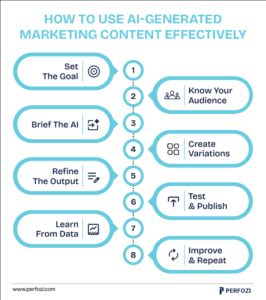
You can use AI-generated marketing content effectively by following eight steps that start with a clear goal and end with learning from performance.
- Start with the marketing objective, because deciding whether you want leads, sales, sign-ups or awareness before opening any tool shapes every prompt that follows.
- Define the audience by noting who they are, what they already know, what worries them and which funnel stage they are in, since that context is what makes the output specific.
- Give the AI the right context, and HubSpot suggests including a role, the tone you want, examples of past work and constraints such as avoiding ROI claims without data.
- Generate multiple variations instead of one, since choice is what makes testing possible.
- Review and refine by fact-checking every claim, cutting generic lines and adding your own data, quotes and examples.
- Publish or test, running variations as split tests wherever the channel allows it.
- Learn from performance by looking at which angle, format and audience worked and trying to understand why.
- Improve the next iteration by feeding the winners back into the next brief as examples.
Salesforce also advises starting with simple applications and expanding gradually instead of rolling out large-scale AI overnight, which is sensible for most teams.
AI Marketing Tools: Where They Fit
AI marketing tools fall into a handful of groups, and the tool should follow the marketing job instead of the other way around, so it helps to start from the task. The names below come from the cases in this guide, so treat them as examples and not as a ranking.
- Writing and content: ChatGPT and Claude
- Image generation: DALL-E and Midjourney
- Video: Runway, Veo 3, HeyGen and Synthesia
- Ad creative and testing: Buzzly, as used in the Barilla case
- Email: AI copy and testing features built into email platforms
- Automation: n8n workflows
- Analytics and personalization: platforms such as HubSpot and Salesforce, which build AI assistants into their CRMs
If you cannot describe the job in one sentence, you are probably not ready to choose a tool yet.
What Does the Future of AI-Generated Marketing Content Look Like?
Expect more content variation, deeper personalization and faster experimentation, with people still directing the work. Salesforce suggests AI may eventually help build campaign briefs, content and customer journeys together while a human stays in the driver’s seat, which points to a future of human and AI collaboration, so the teams that learn to brief, review and test well will benefit most.
FAQs
What is AI-generated marketing content?
It is any marketing asset, such as copy, images, video, ads or emails, that generative AI creates or heavily helps create, and a person usually guides it with a brief and reviews the result before it goes live.
How is AI used in marketing?
Marketers use AI to create content, personalize messages, test ad variations, analyze data and automate repetitive tasks, so content creation is one use among several.
What are examples of AI in marketing?
Popeyes’ AI-made rap video, Barilla’s AI-tested Meta ads and Zomato’s personalized celebrity ads are three real AI in marketing examples, and together they show AI helping with social, paid and personalized campaigns.
What types of marketing content can AI generate?
AI can generate written copy, images, videos, ad creatives, emails, product descriptions and personalized variations of all of these.
Can AI generate ad creatives?
Yes, AI can generate ad copy, images and video ads and can produce many versions of each for testing, though the results still need human review and performance testing to be worth publishing.
How does AI generate marketing content?
Generative AI learns patterns from large amounts of existing content and then creates new text, visuals or audio from a prompt, and clear prompts with context, examples and constraints usually produce better output.
What are the benefits of AI-generated content?
The main benefits are faster production, more variations to test, easier personalization and more scalable marketing operations, and time savings is the top reason marketers give in HubSpot’s survey.
What are the disadvantages of AI-generated marketing content?
The main disadvantages are inaccurate information, generic output, brand inconsistency and over-reliance on automation, all of which human review can reduce.
Can AI replace human marketers?
No, because AI can produce and test content quickly but cannot set strategy, judge brand fit or bring original ideas, and the best results in the examples above came from people directing AI instead of being replaced by it.
What are the best AI tools for marketing?
It depends on the job, since writing, image, video, ad testing, email and automation tools all serve different needs, so start with the task you want to improve and pick a tool after that.
Final Thoughts
AI generated marketing content works best when it is treated as a faster way to carry out good marketing thinking and not a shortcut around it, and the brands in this guide saw real gains because they paired AI with clear goals, human review and honest testing. If you want help turning AI-assisted production into campaigns with measurable results, Perfozi can help you build that mix of speed, strategy and accountability.