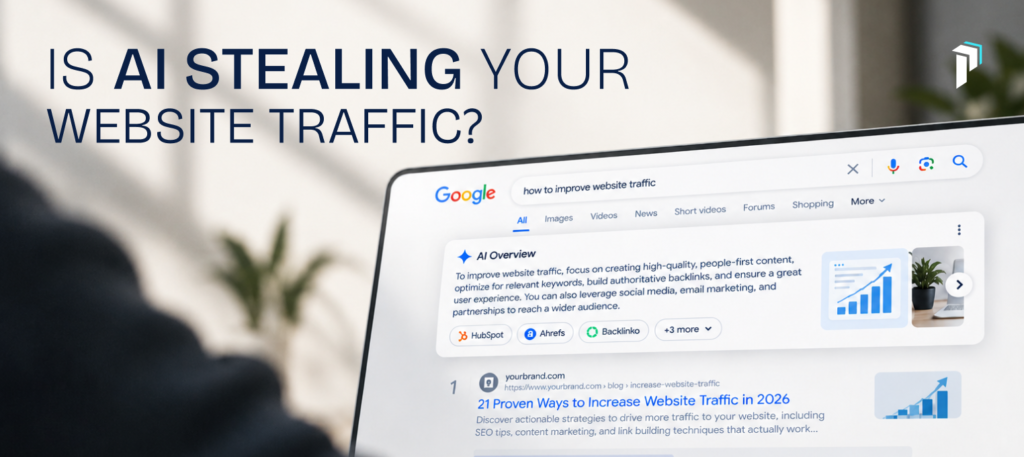
Quick overview: AI Overviews appear above the normal search results and answer many questions before anyone clicks a link, and that has made AI Overviews SEO a real concern for anyone watching AI Overviews website traffic or AI Overviews organic traffic trends. Research shows a meaningful drop in click-through rate (CTR) on the top-ranking page when an AI Overview appears, though the size of that drop is not the same for every site or search. This guide explains what is actually happening to clicks, what SEO should optimize for now, and how to measure success when a page can win without earning a click at all.
You can rank first for a search and still get fewer visits than you used to, because Google now often answers the question directly on the results page before anyone reaches your link. This has added a new layer between the searcher and your website, and it raises a real question worth sitting with: if Google can answer the question before someone visits your site, what exactly is SEO supposed to accomplish now?
What Are AI Overviews and Why Do They Matter for SEO?
An AI Overview is a short, AI-written summary that Google places above the normal search results for many queries, and it answers the question directly using information pulled from a handful of cited web pages. It sits in a space traditional organic listings used to occupy, so a page can still rank first below it and never get seen, because the summary alone can satisfy what the searcher was looking for. This differs from a regular organic result, since a normal listing simply points to a page, while an AI overview in SEO terms competes with that page for the click itself. That single change is why AI overview affects SEO across the whole search journey, and not just around the moment someone types a query.
Are AI Overviews Actually Reducing Website Traffic?
Yes, but the honest answer needs a number attached to it, along with an explanation of what that number does and does not cover. AI Overviews impacting SEO is not a rumor, since Ahrefs studied 300,000 keywords using aggregated Google Search Console data and found that when an AI Overview appears, the top-ranking page’s average click-through rate is about 58% lower than a modeled estimate of what it would have been without one. Pew Research, watching real people search found that a traditional result was clicked on only 8% of visits when an AI summary appeared, compared with 15% when it did not, which points the same direction from a completely different angle.
That said, this does not mean every website will lose 58% of its traffic, and the nuance behind that figure is worth explaining. Ahrefs’ own effect gets smaller at lower ranking positions, running from 58% at position one down to about 19% at position ten, and Search Institute’s review of the same data points out that the 58% is a gap between an observed rate and a modeled forecast, not a straightforward before-and-after drop. Other studies back this up, since Seer Interactive found that being cited inside an AI Overview cut the damage roughly in half compared with appearing below one without a citation, and Amsive found branded searches barely triggering AI Overviews at all, with their click-through rate rising rather than falling. So the real range runs from a small dip on a branded, commercial-intent query to a heavy loss on a generic, informational one where the AI Overview fully answers the question on its own.
The real problem isn’t that Google has become less useful, but that the old definition of SEO success has become too narrow. For years, success meant one thing, which was a click, and clicks are still real and still matter, but treating them as the only outcome misses the fact that a searcher who reads your brand’s name in an AI Overview, without clicking, may still remember you the next time they’re ready to buy.
Suggested Reads: How Brands Can Improve Their Visibility and Reputation in AI Search
The Bigger Shift: From Ranking for a Query to Being Visible Across the Search Journey
SEO used to follow a short, simple path, where a search led to a ranking article, the article led to a click, and the click led to a website visit. That path has stretched out, because the emerging model now runs from a search to an AI Overview SEO, then to the sources and citations behind it, then to the regular organic results, and then to brand recognition, with a website visit and a conversion only showing up sometimes at the very end. A customer’s first real interaction with your brand is no longer guaranteed to be a website visit, since it might now be nothing more than your name appearing inside an AI Overview, days or even weeks before they ever click through to your site.
That’s why visibility, authority and brand discovery deserve to be built on purpose now, rather than treated as happy side effects of a good ranking. Tracking only position one and organic clicks means watching a single narrow slice of a much longer journey, and it hides most of the ways a page can still be doing real work for your brand even when nobody clicks it.
Suggested Readings: 5 Proven Ways to Build Brand Authority in AI Search
What Should SEO Actually Optimize for in 2026?
SEO in 2026 should optimize for being cited and remembered across the whole search journey, not only for holding position one, and that shift changes what “doing SEO well” actually means in practice.
Don’t Abandon Traditional SEO
Technical SEO, crawlability, indexing, relevance and authority still matter, and in fact they matter more than ever, because an AI Overview SEO strategy still has to find, understand and trust your page before it can cite it. Think of AI optimization as an evolution of SEO rather than a replacement for it, since a page that Google can’t crawl or trust has no chance of being cited, no matter how well it’s written for AI.
Suggested Readings: Is Your SEO Really Working? 12 KPIs That Show What Your Website Is Actually Doing
Create Content Worth Citing, Not Just Content Worth Ranking
If an AI system is summarizing ten sources to answer one question, you have to ask yourself why yours should be one of them, and “because it ranks” is no longer a strong enough answer on its own. Original insight, first-hand experience, real data, clear answers and expert commentary are what push a page from “technically relevant” to “worth quoting”, and a page built only to rank, with no real point of view or evidence behind it, blends into the same pile every competitor is also feeding the AI system.
Cover the Topic, Not Just the Keyword
How to optimize content for AI Overviews starts with covering a topic fully instead of chasing one exact phrase, since AI systems synthesize an answer from related questions, entities and context, not from a single keyword match. A page that only answers the exact query in the title, while ignoring every follow-up question a reader would naturally have next, gives an AI system little reason to treat it as the authoritative source on the subject.
Make Content Easy to Understand and Extract
Clear headings, direct answers stated early, a logical structure and concise explanations all help both a human reader and an AI system pull out exactly what they need, and a table can help too when it genuinely organizes something worth comparing. The goal here isn’t to write for robots, since making content easier for a human to understand is usually what makes it easier for a search system to interpret as well, and those two goals rarely pull in different directions.
SEO Metrics Need to Change Too
If a click is no longer the only outcome that matters, then a scoreboard built only around clicks is missing most of what a good SEO program now achieves. Rankings, organic clicks, click-through rate, impressions and conversions are all still worth tracking, but AI Overview visibility, citations, brand mentions, query-level visibility, branded search growth and conversion quality now belong on that same scoreboard, because they capture the parts of the journey clicks alone can’t see.
Measuring all of this is harder than it sounds, since Google doesn’t hand marketers a clean, dedicated “AI Overview traffic” metric inside standard reporting, and any click from inside an AI Overview SEO typically shows up simply as ordinary Google organic traffic with no way to separate it out. Ahrefs describes this measurement gap in detail, and the practical workaround most teams use is to compare CTR before and after known AI Overview rollout dates, and to watch for pages where rankings and impressions stay flat while CTR quietly falls, a pattern often called the “great decoupling,” since it signals lost clicks without any actual loss of visibility.
What Should an SEO Service Actually Look Like in 2026?
If a business hired an SEO agency today, the fair question to ask is what that agency should actually be doing differently than it would have five years ago. The honest answer is that modern SEO needs to combine technical SEO, content built to be cited, authority building, broader search visibility and measurement that goes beyond clicks, all working together rather than treated as separate line items on an invoice.
That combination is the natural shape SEO takes once you accept that AI Overviews haven’t erased the fundamentals but have added new layers on top of them, and it’s the direction we build AI Overviews SEO strategy toward at Perfozi.
A Practical Example: Winning Visibility Even When Clicks Drop
Here’s a hypothetical scenario, built from patterns seen across the research above, to show what this shift looks like in practice. Picture a mid-sized software company whose top blog post, answering a common “what is X” question in their category, had held position one for two years and reliably drove a steady stream of organic signups.
Once an AI Overview began appearing for that exact query, the page kept its position one ranking and its impressions stayed flat, but organic clicks fell by roughly 40% within two months, which is the decoupling pattern described above playing out almost exactly. Instead of panicking, the SEO team checked whether the page was actually being cited inside the AI Overview, and it wasn’t, since a competitor’s more detailed comparison page was winning that citation slot instead.
The fix wasn’t to abandon the page, but to rebuild the section the AI Overview was drawing from, replacing a generic paragraph with a clear, direct definition backed by original data from the company’s own product, then adding a comparison table addressing the natural follow-up questions a reader would have next. Within six weeks, the page began appearing as a cited source inside the AI Overview itself, and while raw clicks never fully returned to their old level, branded search volume for the company’s name rose over the same period, and the leads that did convert from that page were more qualified than before, since a searcher who reads your definition inside an AI Overview and still clicks through afterward is showing far stronger intent than someone who clicked blind.
The lesson holds even as a hypothetical, since ranking wasn’t disappearing in this scenario. The definition of visibility was simply expanding to include a step before the click.
Our Take: SEO Isn’t Dead, the Old Definition of SEO Is
The mistake would be treating AI Overviews as a reason to abandon SEO altogether, but the bigger mistake would be continuing to measure SEO exactly as we did five years ago, as if clicks were still the only thing that counted. SEO isn’t becoming less important, but it is becoming less linear, and the job has shifted from a narrow goal of “get us to position one” toward a broader one of “make us visible wherever the search journey actually happens,” whether that’s inside an AI Overview, a citation, a branded search or a traditional click.
Conclusion: Adapt the Strategy, Not the Panic
The honest conclusion isn’t that AI Overviews are killing traffic outright, but that AI Overviews are changing the relationship between rankings, visibility and clicks, and that relationship now needs a wider set of metrics and a wider definition of success to make sense of it. Businesses should adapt their SEO strategy around visibility, authority, genuinely useful content and measurable business outcomes, rather than treating organic search as something to abandon just because the old scoreboard no longer tells the whole story.
FAQs
How do you show up in AI Overviews?
You show up by earning a citation, which means publishing content specific and well-supported enough that an AI system chooses it as one of its sources, usually because it answers the question more clearly or with better evidence than competing pages.
What triggers an AI Overview?
AI Overviews tend to trigger most often for informational, question-based searches where a direct, factual answer can satisfy the searcher without requiring them to compare options or make a purchase decision.
How does AI Overview ranking differ from traditional SEO?
Traditional SEO rewards relevance and authority to earn a ranking position, while getting cited inside an AI Overview additionally rewards content that is specific, well-structured and genuinely worth quoting, since the AI system is choosing sources to summarize rather than simply ranking pages.