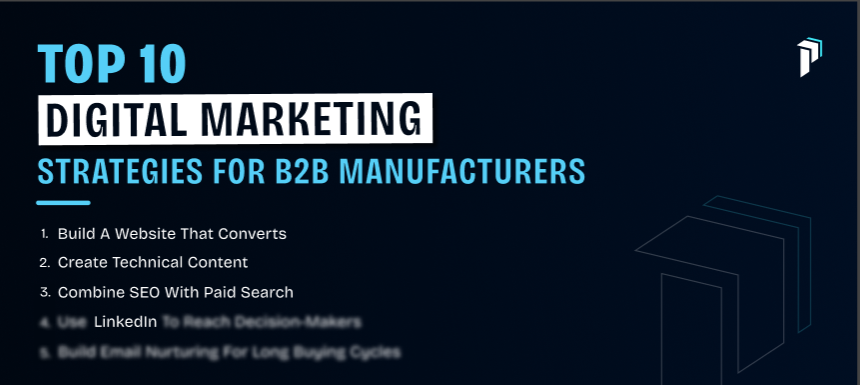
Overview: Digital marketing for manufacturers works differently than typical B2B marketing. Buyers research for months before they ever talk to sales, multiple people sign off on one purchase, and most of what convinces them is technical, not emotional. This guide covers 10 practical strategies from your website to paid search to measurement, built around one idea: help the right buyer find you, understand you, trust you, and buy from you.
If you sell to other businesses in manufacturing, you already know the buying process is slow.
An engineer finds you first, a procurement manager checks your pricing next, a plant manager wants proof you won’t cause downtime.
Your marketing has to speak to all three, at different times, without losing any of them.
Most digital marketing advice is written for consumer brands where it talks about brand awareness and social buzz. That advice falls apart the moment a buyer asks for a spec sheet or a certification. However, manufacturing buyers need facts, not slogans.
Digital marketing for manufacturers isn’t about being visible everywhere. Rather, it’s about being visible and useful when the right buyer is researching a supplier. That single idea shapes every strategy below.
1. Build a Website That Converts Technical Buyers
Your website is not a brochure. For most manufacturing buyers, it’s the first real interaction they have with your company, often weeks before anyone calls you.
- A strong manufacturing marketing strategy starts with a website built around what buyers actually need to see, so it should include clear positioning on your homepage, detailed product and service pages, and application pages that show how your products solve specific problems in specific industries.
- Add technical specifications, certifications, and case studies too, since buyers use these to shortlist suppliers before they ever pick up the phone, and product documentation should be easy to find rather than buried three clicks deep.
- Give buyers a clear next step, whether that’s a “Request a Quote” button or a direct contact-sales option, because not every buyer is ready for the same type of conversation.
- Check your mobile experience and page speed as well, since many buyers browse supplier sites on a phone during a shift break, and a slow page loses them fast.
Treat your website as a digital sales asset rather than simply a company brochure and every other strategy on this list will work better because of it.
If you want to go deeper on what makes a site easy for search engines to understand, Google’s own SEO Starter Guide is a solid place to start.
Also Read: Mastering Conversion Rate Optimization for Your Business
2. Use SEO to Capture High-Intent Manufacturing Searches
SEO for manufacturers works best when you target buyer intent instead of chasing search volume.
Target product keywords, application keywords, and industry-specific searches your buyers actually type, and pair these with problem and solution searches, since many buyers search for their pain point before they even know what product solves it. Round this out with technical queries and commercial-intent terms like “supplier” or “quote,” because these searches sit closest to an actual purchase decision.
This is where digital marketing for manufacturing companies looks different from most SEO advice, since a keyword with lower search volume but clear buying intent is often worth more than a high-volume term with no commercial signal behind it.
Optimize your product and service pages with this in mind, and fix technical SEO basics too, since site speed, mobile usability, and clean site structure all affect whether Google trusts your pages enough to rank them.
Optimize for buyer intent rather than search volume alone and the rest of your SEO effort will follow the right direction.
Google’s SEO documentation covers the technical fundamentals in more depth if your team needs a refresher.
3. Create Technical Content That Helps Buyers Evaluate You
Content marketing for manufacturers works when it answers a real question your buyer is asking right now, not when it fills a content calendar.
Write technical guides, application guides, and product comparisons, and add FAQs that reflect the actual questions your sales team hears on calls. White papers and case studies work well for buyers deep in evaluation, while buying guides and troubleshooting content serve buyers earlier in the process, since they’re often still figuring out what they even need.
Before you publish anything, ask whether an engineer, a procurement manager, or a plant manager would actually learn something useful from the page, because if the honest answer is no, the content isn’t ready yet.
Publish the information a real decision-maker needs to evaluate you, not content you’re writing simply because you need a blog post.
4. Combine SEO With Paid Search
SEO and paid search solve two different problems, so a solid digital marketing strategy for a manufacturing company usually needs both.
SEO builds visibility that compounds over months and years, while paid search gets you in front of high-intent buyers today, even while your organic content is still climbing the rankings. Use PPC around your most commercially valuable search terms, since these are the ones tied closest to an actual purchase decision.
Use your search data both ways too, because paid campaigns often reveal which keywords convert best, and that data can guide your SEO content plan in return. Set up retargeting for visitors who leave without converting, since a single site visit rarely closes a B2B manufacturing marketing sale, and always send paid traffic to a landing page built for that specific search rather than your generic homepage.
Google’s guide on creating a Search campaign is a useful reference if your team is setting this up for the first time.
5. Use LinkedIn to Reach Decision-Makers
LinkedIn earns real investment in manufacturing marketing because it’s where your actual buyers spend time professionally, unlike most other social platforms.
Post company updates, but don’t stop there, since thought leadership from your engineers or subject matter experts tends to perform better. Technical insights, case studies, and product or application education all work well because they speak directly to the people evaluating you, and industry commentary helps too, since it shows buyers you understand their world, not just your product.
LinkedIn advertising with account targeting lets you put content directly in front of the specific companies and job titles involved in a purchase decision, and this matters more in manufacturing than almost any other B2B sector, since buying committees are often large.
LinkedIn works when you use it to reach the people involved in the buying process, not just to build followers.
6. Build Email Nurturing for Long Buying Cycles
A form submission is not a sales-ready lead, and in manufacturing, the gap between first contact and a signed order can stretch for months.
Set up a sequence for new leads that introduces your company without overselling, and build product-interest sequences based on what a lead downloaded or clicked. Educational emails keep you useful during the research phase, while quote follow-up emails keep you top of mind after a buyer has already shown real intent.
Segment your list and use behavior-based triggers so the right email reaches the right person at the right stage, since a buyer who just downloaded a spec sheet needs a different email than one who requested a quote three weeks ago.
A lead that goes quiet for weeks isn’t a dead lead, since that’s simply a long buying cycle doing exactly what it normally does.
7. Use Account-Based Marketing for High-Value Accounts
Account-based marketing earns its place for high-value accounts with long sales cycles and multiple stakeholders, though it isn’t necessary for every manufacturer.
Start by identifying your target accounts and mapping the buying committee inside each one, since manufacturing purchases often involve an engineer, a procurement lead, and a plant or operations manager, each with different priorities. Build messaging specific to each account and each role, then combine LinkedIn, paid media, content, and email to reach them consistently.
None of this works without close alignment between marketing and sales, because sales knows who’s actually in the room for a given deal, and marketing needs that information to target the right people.
ABM makes the most sense when you have a short list of high-value accounts worth this level of investment, rather than as a blanket strategy for every lead that comes in.
8. Connect B2B Manufacturing Marketing Automation With CRM
Digital leads disappear after a form submission more often than they should, and this remains one of the most fixable problems in B2B manufacturing marketing.
Connect your marketing automation to your CRM so leads get scored automatically based on their behavior, and set up automated follow-up and behavioral triggers, so a lead who visits your pricing page three times gets a different response than one who reads a single blog post. Lead qualification rules help your sales team focus on leads actually ready for a conversation.
Make sure your CRM integration includes sales notifications and lead-to-opportunity tracking too, so nothing gets lost between marketing and sales handoff.
Don’t let digital leads disappear after they fill out a form, since that gap is exactly where good pipeline quietly goes to waste.
9. Use Video to Explain Complex Products
Video closes the gap that text alone often can’t, since manufacturing products are frequently hard to explain in writing.
Product demonstrations and application videos show buyers exactly how something works, which builds more confidence than a written spec sheet ever will. Technical explainer videos and manufacturing process videos work well for buyers who want to understand your capabilities before committing, while customer testimonials add credibility from a source buyers trust more than your own marketing.
Post these on YouTube as well, since it doubles as a search engine for exactly this kind of content, and much of this video content can be repurposed from technical knowledge your team already has, like a training video or an internal process walkthrough.
Show buyers how the product works instead of relying entirely on text, and the rest of your content becomes easier to trust too.
10. Measure Marketing Against Pipeline and Revenue
Impressions, likes, and follower counts don’t mean much if they never turn into sales, and raw website traffic on its own tells you even less.
Measure what actually matters to the business instead, including qualified leads, conversion rate, and cost per qualified lead, and track marketing-sourced pipeline and account engagement as well, especially if you’re running ABM. Look at how many leads turn into real opportunities, and how much marketing activity moves a deal through the sales cycle, since revenue attribution ties the whole picture together.
This is the difference between a manufacturing marketing strategy that looks good in a slide deck and one that actually grows the business.
Google’s guide on using data to optimize Search campaigns is a good reference for setting up conversion tracking that reflects real business value, not just clicks.
Also Read: How We Earned 142 Editorial Links From One Data Study: A Digital PR Playbook
How to Put These 10 Strategies Into a Marketing Plan
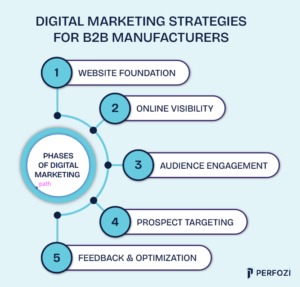
These 10 strategies work best in a specific order rather than all at once.
Start with Phase 1: Foundation, since your website, your positioning, and your tracking setup need to be in place before anything else works well.
Layer in Phase 2: Visibility next, combining SEO, technical content, and paid search, so buyers can actually find you when they start researching.
From there, move into Phase 3: Engagement, adding LinkedIn, video, and email nurturing to keep buyers engaged through a long research and evaluation process, followed by Phase 4: Targeting, where account-based marketing and automation come in for your highest-value accounts once your foundation and visibility are solid.
Finish with Phase 5: Optimization, measuring pipeline and revenue impact and using that data to refine everything above it.
Conclusion
B2B manufacturing marketing isn’t about being everywhere, but about helping the right buyers find you, understand you, trust you, engage with you, and buy from you, in that order.
Start with the foundation, then build visibility around real buyer intent rather than just search volume, and keep buyers engaged through a long cycle instead of expecting a fast close. Measure results against pipeline and revenue rather than vanity numbers, and the whole plan holds together.
That’s a digital marketing strategy built for how manufacturing buyers actually make decisions, not how a typical B2B playbook assumes they do.
Want help building this out for your business? Perfozi works with manufacturers to turn strategies like these into a working, measurable marketing plan.
Frequently Asked Questions
- How long does it take to see results from digital marketing for manufacturers?
SEO and content usually take three to six months to show real traction, since manufacturing buying cycles are long, though paid search can generate leads faster, often within weeks. - What’s the difference between B2B manufacturing marketing and regular B2B marketing?
Manufacturing buyers rely more heavily on technical proof, involve more stakeholders in one purchase, and take longer to decide, so marketing needs to support all three of those realities at once. - Do small manufacturers need all 10 strategies?
No, since starting with the foundation phase, website, SEO, and content, then adding paid search, LinkedIn, and nurturing as budget allows, works better, and ABM and automation can wait until you have a working pipeline.