
Have you ever noticed that you publish blog after blog but still don’t rank? On the contrary, your competitor writes half as much as you do and beats you anyway.
So then you decide to write blogs that can help you rank better where you run a content gap analysis strategy. Your content gap analysis tool throws out a list of keywords they rank for, and you don’t. Based on that, you write five new posts to close that list. But still, traffic barely moves. Why?
Because the list was never the real gap, it just looked like one.
A content gap is not something your competitor has that you don’t. It’s something your reader needs and your content doesn’t give them clearly, deeply, or in the right way. Your competitor’s ranking is just a clue that this need exists, it’s not the need itself. If you chase the clue and ignore the need, you’ll keep writing content that matches your competitor’s list but still misses your reader.
This guide shows you how to do a competitive content gap analysis the right way, not just through a list of keywords. Let’s take a real look at what your content is missing, why it’s missing it, and how to fix it, including the parts most SEO content gap analysis guides skip.
What Is Content Gap Analysis?
Content gap analysis means finding the topics, questions, and details your reader needs that your content does not cover, or does not cover well.
That’s the simple part, the hard part is knowing what “cover well” really means. Most guides skip this. But, we won’t!
Content gap vs. keyword gap
People use these two words like they mean the same thing. They don’t! Mixing them up is the number one reason SEO content gap analysis fails.
A keyword gap is just data. It’s a list of words your competitor ranks for, and you don’t. Any content gap analysis SEO can build this list for you in seconds. It takes no thinking.
A content gap takes thinking. It asks: does your content actually answer the question behind that keyword? Not just touch it. Answer it, fully, the way your reader wants it answered.
You can cover every keyword on that list, write a page for each one, and still have a content gap because the pages don’t actually answer the problem that your target audience is searching for.
Why SEO Content Gap Analysis Matter
Content gaps hurt you in four different ways. Most teams only check for one.
- Missing topics: You have not written about this at all. This is the easiest gap to spot. It’s also usually the smallest opportunity, because it’s the one every tool already shows you.
- Missed search intent: You wrote about the topic. But not the way your reader wanted it. Say someone searches for a content gap analysis tool and they want a list of tools or a recommendation. If your page is a long explainer on what content gaps are, then you’re on the right topic and still missing what they came for.
- Weak or thin coverage: You have covered a topic and the page exists. It sits on page two of Google but nobody reads past the first line. This isn’t a missing topic, it’s a topic your content doesn’t handle well and that’s the exact line between a keyword gap and a real content gap.
- Gaps in the buyer’s journey. You’ve covered the topic in general but you skipped the one stage your business actually needs, maybe a comparison page for someone ready to buy, or a how-to guide for someone who already bought. The reader doesn’t need “more content”, they need content built for where they are right now.
A competitive content gap analysis only ever catches the first one. That’s why a deeper understanding matters more than software here.
The 5 Types of Content Gaps
Most articles on SEO content gap analysis stop at “you’re missing a topic”. That’s only one gap out of five.
- Topic gap: Your reader has a question but you have no page that answers it. It’s an opportunity that you lost.
- Intent gap: You do have a page but it doesn’t exactly answer what the reader wants. They want a quick answer, you gave them a long story. They want a comparison, you gave them a definition.
- Depth or quality gap: The page is there but it’s just too short, too old, or too shallow to actually solve the reader’s problem.
- Format gap: The words are fine but the reader (or Google) expects a format that includes relevant headers, images, table, and bullet points. But all you give them is plain text.
- Originality gap: Your page says the same thing as every other page on the internet. There’s no new idea, no new data, no reason for a reader or an AI tool to pick your page over anyone else’s.
Only the first type shows up in a keyword tool. The other four need a human to actually read the page and judge it.
How to do a Content Gap Analysis
Having discussed what Content Gap analysis is, let’s get into lab-mode, where we understand how to actually do it.
Step 1: Audit your existing content
Before looking at other’s websites, it’s best to start with your website. List every page you’ve published, add its rankings, traffic, and how long people stay on it. This is your starting point! You can’t spot a gap in content you haven’t mapped out first.
Step 2: Identify the right competitors
Don’t just pick your biggest business rival. Pick your content rivals, whose content actually shows up and gets read for the topics your reader searches. Sometimes that’s a small blog, a forum thread, or even a tool’s help page, not the company you compete with for sales.
Step 3: Compare keyword and topic coverage
This is the step most SEO content gap analysis tool do for you. It’s a fine place to start but just don’t stop here, use this list to find topics worth digging into, not as your final plan.
Step 4: Analyze the SERPs and search intent
For each topic on your list, open Google and look at what actually ranks. Is it product pages? Long guides? Videos? Forum posts? This tells you what the reader actually wants better than the tool alone ever could. Getting this step wrong is the most common cause of an intent gap.
Step 5: Research what your audience actually needs
Now go past Google. Read support tickets, read the comments on forums like Reddit and the reviews. Look at “People Also Ask” boxes. This is where you find your reader’s real words and real questions, the ones a competitor’s ranking page might not even show you. This step exists because the whole point of content gap analysis strategy is to find your reader’s need, which may not be covered on your competitor’s page.
Step 6: Identify and classify the gaps
Take every gap you found and sort it into one of the five types from Section 3. This matters because the fix is different each time.
- A topic gap needs a brand-new page.
- A depth gap needs a rewrite.
- A format gap might just need a table added, not a single new word.
Step 7: Prioritize the gaps worth fixing
You don’t need to fix every gap, some aren’t worth it. Weigh how many people search for it, how much it matters to your business, how hard it will be to rank, and how strong your competitor already is. A small gap that sits right in your buyer’s path can matter more than a big gap that brings the wrong kind of visitor.
Turn Competitive Content Gap Analysis Into an Action Plan
Finding gaps means nothing if you don’t act on them. Sort every gap into one of these five buckets:
- Update existing content: For pages with good content but weak depth, intent, or format.
- Create new content: Only for real topic gaps, where nothing exists yet.
- Consolidate overlapping content: When three thin pages are fighting each other instead of one strong page winning.
- Improve format or depth: Add the table, the video, the data point, the visual, whatever the gap actually needs.
- Build a content roadmap: Put every fix in order, by priority, so the plan survives past this month.
How AI Search Changes SEO Content Gap Analysis
For years, content gap analysis meant one thing: someone types a keyword into Google and clicks a link. That’s no longer the whole story.
- Traditional keyword gaps vs. AI visibility gaps. A keyword gap asks, “does a page exist for this term?” An AI visibility gap asks a different question, “does an AI tool actually pull your content when it answers this question?”. Those two answers don’t always match.
- LLM prompts and questions. People don’t type short keywords into AI chat tools. They ask full, natural questions, sometimes several in one go. If you only plan around keywords, you’ll miss the real phrasing your reader is using.
- Extractability AI tools favor pages that are easy to pull answers from. This means clear definitions right at the top of the page with clear headers. A page can rank fine in Google and still be invisible to an AI answer, simply because it’s not optimized for AI. Nowadays, most links that rank on Google get skipped just because AI overview answers it.
- Original information and value AI answers often pull from the same handful of sources, over and over. A page with real data, a real framework, or a real point of view has a shot at being that source. A page that repeats what everyone else already said does not. This is the originality gap from Section 3 , just with much higher stakes now.
None of this changes the core idea. A gap is still a reader’s need your content doesn’t fully answer. What’s changed is where that need shows up and what “fully answer” now demands.
Also, read: How to Optimize Content for AI Search and Discovery
How to Measure Whether You Closed the Gap
Publishing a fix is not the finish line. You still have to check if it worked. These are the factors that we usually check:
- Rankings: Did the page actually move up for the topic and the related terms around it?
- Impressions: Is the page now showing up for more related searches, not just the one you targeted?
- Organic traffic: The clearest number, but only useful alongside other KPIs, not alone.
- Engagement and conversions: Do people stay, scroll, and act? This tells you if the content actually helped, once they arrived.
- AI and search visibility: Is your page getting cited or pulled into AI-generated answers?
If your rankings go up but nobody stays on the page or converts, that’s a warning sign. You may have matched the keyword but you still haven’t matched the need. We fix this by performing a content gap analysis strategy, which we have summarized in the next section.
Content Gap Analysis SEO: A Practical Checklist
Let’s summarize everything that we discussed so far into a handy checklist.
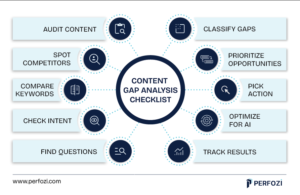
- List all existing content with performance data attached
- Find your real content competitors, not just business rivals
- Pull a keyword and topic comparison
- Check the SERPs to confirm intent for each topic
- Collect real reader questions from sales, support, and forums
- Sort every gap into one of the five types
- Rank gaps by reader need, business value, and effort
- Decide: update, create, or merge for each gap
- Check if pages are easy for AI tools to pull answers from
- Set a date to measure results, not just rankings
FAQs
1. What’s the difference between a content gap and a keyword gap?
A keyword gap is a term your competitor ranks for and you don’t. A content gap is a real reader need, your content doesn’t fully answer, and it might not even show up as a missing keyword. This is why knowing how to do a content gap analysis is very important.
2. How often should I do a content gap analysis?
Every few months for most active blogs. Do a quick check anytime a competitor publishes something big, or your rankings suddenly drop.
3. Can a content gap analysis tool do all of this for me?
Tools are great at the first few steps: listing content, finding competitors, comparing keywords. They can’t judge intent, depth, or originality. Treat the tool’s output as a starting list, not a finished plan.
4. Do I need to write new content to close every gap?
No. Most gaps close faster by fixing an existing page’s depth, format, or intent, not by writing something brand new.
5. How is AI search changing content gap analysis?
It adds one more thing to check, not just whether you rank for a keyword, but whether AI tools actually pull and cite your content when they answer the question behind it.