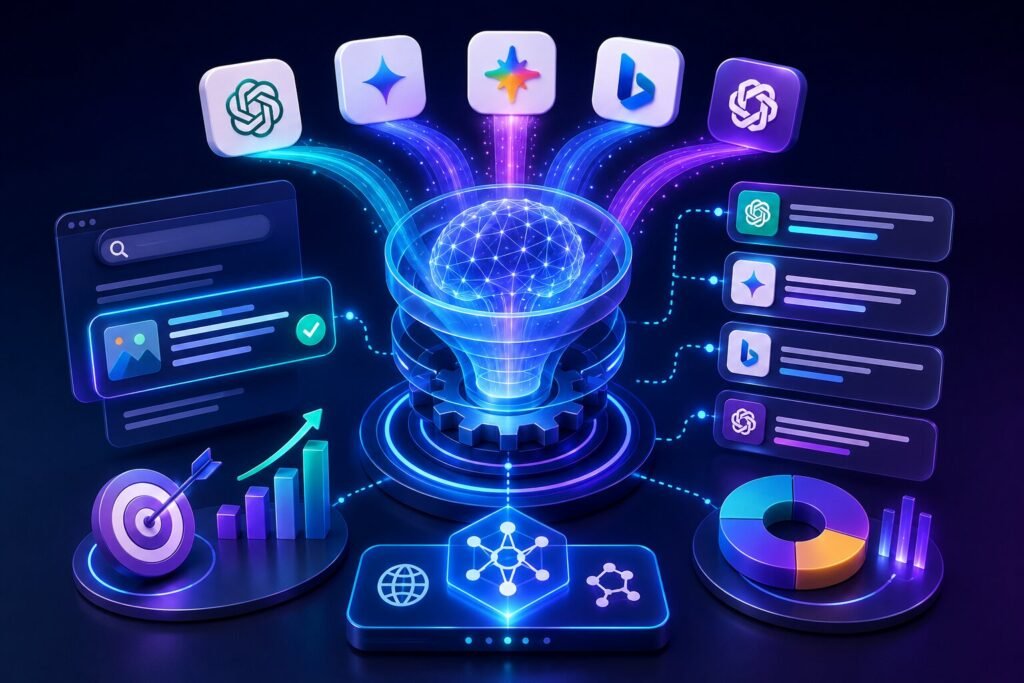
Search visibility is no longer limited to where a website appears on Google.
People are increasingly asking ChatGPT, Perplexity, Gemini, Google AI Overviews, and other AI-powered search experiences for recommendations, comparisons, and answers. Instead of browsing ten links, they may receive a response that mentions only a handful of businesses or sources.
That creates a new marketing question:
Is your brand visible when potential customers ask AI about your industry?
This is where Generative Engine Optimization (GEO) comes in.
GEO tools help marketers monitor how brands appear in AI-generated answers, identify which sources are being cited, compare visibility against competitors, and find opportunities to improve content. The category has expanded quickly in 2026, with tools ranging from dedicated AI visibility platforms to broader SEO suites adding generative-search features.
But not every GEO tool does the same thing. Some are designed mainly for tracking mentions, while others focus on competitor research, content optimization, reporting, or broader SEO workflows.
Here are some of the tools worth knowing in 2026.
What Should a GEO Tool Actually Do?
Before comparing platforms, it helps to understand what you are buying.
A useful GEO platform should help answer questions such as:
- Does AI mention my brand?
- Which prompts trigger that mention?
- Which competitors appear instead?
- Which websites are being cited?
- How often are my pages referenced?
- Is my visibility improving over time?
- What content opportunities are we missing?
The strongest tools go beyond a simple visibility score. They help turn AI-search data into actions for content, SEO, and digital marketing teams.
1. Profound – Built for Enterprise AI Visibility
Profound is one of the better-known platforms in the emerging GEO space and is positioned toward businesses that need deeper AI-search intelligence.
Its focus is on monitoring how brands appear across generative search experiences and understanding the competitive landscape.
This type of platform can be useful for larger organizations with multiple markets, products, or brands to monitor.
Best for: Enterprise teams, large brands, and organizations that need detailed AI visibility reporting.
Consider it when: You need more than occasional checks and want ongoing visibility intelligence across a larger search strategy.
2. Peec AI – Useful for Monitoring AI Visibility
Peec AI is another dedicated platform focused on monitoring brand visibility in AI search.
Its approach centers around tracking prompts, mentions, competitors, and changes in AI visibility. Current industry comparisons commonly place Peec AI among the dedicated GEO monitoring platforms worth evaluating in 2026.
For agencies and marketing teams, this type of monitoring can make it easier to understand whether content and SEO improvements are translating into stronger AI presence.
Best for: Marketing teams and agencies looking for dedicated GEO monitoring.
3. Otterly.AI – A Practical Starting Point
Otterly.AI is aimed at businesses that want to monitor their visibility across AI search without necessarily building a complex enterprise setup.
It can help marketers see whether brands appear for important prompts and understand how competitors are being represented.
That makes it particularly useful when you are just beginning to establish a GEO measurement process.
Best for: Smaller businesses, marketers, and teams that want a simpler AI visibility workflow.
4. AthenaHQ – Focus on AI Search Intelligence
AthenaHQ is another platform appearing in current 2026 GEO comparisons.
Its value is less about traditional keyword ranking and more about understanding how brands and competitors are represented in generative answers.
For businesses already investing heavily in SEO services, this can provide an additional layer of visibility beyond conventional rank tracking.
Best for: Teams looking for broader AI-search monitoring and competitive insights.
5. Scrunch AI – Useful for Larger Search Strategies
Scrunch AI takes a broader view of AI visibility and search presence.
It is particularly relevant for organizations that want to understand how AI systems interact with their website and brand information.
This can become increasingly useful for larger websites where technical accessibility, content structure, and AI discoverability need to be considered together.
Best for: Larger organizations and teams managing more complex websites.
6. Semrush AI Visibility – Convenient for Existing SEO Users
If your team already uses Semrush, its AI visibility capabilities can be attractive because they bring traditional SEO and generative-search analysis into a broader workflow.
This matters because GEO should not be treated as a replacement for SEO.
Your website still needs strong technical foundations, useful content, relevant authority, and good search visibility.
Combining those activities can make reporting and optimization more practical than managing completely separate systems.
Best for: Existing Semrush users and SEO teams wanting GEO capabilities within a broader SEO platform.
Current 2026 comparisons also identify Semrush’s AI Visibility offering as one of the major hybrid options alongside dedicated GEO platforms.
7. Ahrefs Brand Radar – Connect AI Visibility With SEO Data
Ahrefs is traditionally known for SEO, backlinks, and competitive research.
Its Brand Radar offering adds another angle by helping marketers understand brand visibility in AI-generated search.
This can be useful for teams that already rely on Ahrefs for link building services, keyword research, competitor analysis, and organic search reporting.
The benefit is having traditional SEO intelligence and AI visibility data closer together.
Best for: SEO teams already working within the Ahrefs ecosystem.
8. SE Ranking / SE Visible – For Teams Wanting a Broader SEO Workflow
SE Ranking has also moved into AI-search visibility, making it another option for teams that do not want GEO completely separated from their existing SEO workflow.
For an SEO agency managing several client websites, having traditional rankings and emerging AI visibility metrics within one broader process can simplify reporting.
Best for: Agencies, consultants, and businesses already using an SEO platform.
9. Writesonic – Useful for Content-Focused Teams
Not every GEO tool is primarily about monitoring.
Some focus more heavily on the content side.
Writesonic combines AI-assisted content workflows with optimization features designed around modern search.
This makes it worth considering for teams where content marketing services and content production are a major part of their search strategy.
However, content generation alone should not be confused with GEO. Publishing more AI-generated articles does not automatically make a brand more visible in AI search.
Best for: Content teams that want creation and search optimization in the same workflow.
GEO Tools Are Not a Replacement for SEO
This is probably the most important point in the entire discussion.
A GEO tool can show you that your brand is not being mentioned.
It cannot magically create authority.
You still need a strong website, useful content, technical SEO, relevant links, clear brand information, and a strategy built around the questions your customers actually ask.
Research published in 2026 also highlights that GEO is not simply a single ranking task. Visibility can depend on crawling, retrieval, citations, source selection, and other stages of the generative-search process.
So think of GEO as an additional layer of search optimization rather than a replacement for your existing SEO program.
What Should You Track With a GEO Tool?
Once you choose a platform, avoid getting distracted by dozens of dashboard metrics.
Start with a small set of meaningful measurements.
Brand Mentions
How frequently does AI mention your business when answering relevant questions?
Citation Visibility
Are AI systems linking to or referencing your website and other sources associated with your brand?
Competitor Visibility
Which competitors are being recommended when your business is not?
Prompt-Level Performance
Which customer questions produce strong or weak visibility?
Share of Voice
How often does your brand appear compared with competitors across a defined set of prompts?
Trends Over Time
Is visibility improving, declining, or simply fluctuating?
Repeated measurements matter because AI-generated answers can vary between runs and across platforms. Current research also points to variability in generative-search results, meaning a single test should not be treated as a definitive performance score.
How GEO Fits Into a Broader Marketing Strategy
GEO should not sit in a separate corner of your marketing department.
Your SEO services can improve technical accessibility, content quality, internal linking, and organic visibility.
Your content marketing strategy can answer the questions potential customers ask.
Your brand strategy services can create consistent information about who you are and what you offer.
Your link building services can help build authority through relevant third-party references.
And paid channels such as PPC management services can support visibility while organic and AI-search strategies develop.
The channels work better when they are connected.
How Can an SEO Agency Use GEO Tools?
For an SEO agency, GEO tools can become useful during strategy, reporting, and content planning.
For example, an agency might discover that a client’s competitors are repeatedly recommended for a specific type of question.
Instead of simply reporting the competitor’s visibility, the team can investigate:
- What sources are AI citing?
- What topics do those sources cover?
- Does the client have stronger first-party information?
- Are important questions missing from the client’s website?
- Are credible third-party sources mentioning competitors more frequently?
- Can existing content be improved?
That turns GEO data into a practical SEO workflow.
AI Visibility Prompt for GEO Research
You can also use an AI prompt alongside GEO tools when analyzing your website:
“Analyze this website for Generative Engine Optimization. Identify the questions potential customers are likely to ask AI search engines about this business and its services. Evaluate whether the website provides clear, trustworthy, and sufficiently detailed answers to those questions. Identify missing topics, weak evidence, unclear brand information, citation opportunities, competitor gaps, and content improvements that could strengthen AI visibility. Keep the recommendations natural, useful, and aligned with traditional SEO. Do not recommend keyword stuffing or artificial language.”
The prompt is useful for turning raw GEO observations into a content and optimization plan.
Which GEO Tool Should You Choose?
There is no single best tool for every business.
| Need | Tools worth considering |
|---|---|
| Enterprise AI visibility | Profound |
| Dedicated GEO monitoring | Peec AI, Otterly.AI |
| Broader AI-search intelligence | AthenaHQ, Scrunch AI |
| SEO + AI visibility | Semrush, Ahrefs, SE Ranking |
| Content-focused workflows | Writesonic |
| Agency reporting | Peec AI, Semrush, Ahrefs, SE Ranking |
The market is still developing, so features, pricing, and platform coverage can change quickly. Current 2026 comparisons show that the biggest differences are generally around engine coverage, prompt control, competitor analysis, citation tracking, historical reporting, and optimization workflows.
The Best GEO Tool Is the One You Can Actually Use
GEO is still a developing discipline.
That means businesses should be careful about buying a platform simply because it has an impressive dashboard.
Start with your customers.
Identify the questions they ask. Choose the AI platforms that matter to your audience. Create a consistent prompt set. Establish a baseline. Then use the data to improve your website, content, authority, and overall search strategy.
For businesses working with Perfozi, GEO can become part of a wider performance-focused approach that connects SEO services, content, brand visibility, and measurable marketing outcomes.
Conclusion
AI-driven search is changing the way potential customers discover and evaluate businesses. But getting discovered is only the first step. Once someone reaches your website, the information, experience, and trust signals they find need to give them a reason to take action.
A well-optimized website should clearly explain what your business offers, answer important customer questions, demonstrate expertise, and make the next step easy. At the same time, your SEO, content, local visibility, authority, social media, and paid campaigns should work together rather than operate as separate channels.
For businesses investing in SEO services, the opportunity is bigger than simply gaining another source of website traffic. AI-driven discovery can bring your brand into conversations that happen before a customer even knows which company they want to contact.
The businesses best positioned for this shift will be the ones that focus on useful information, genuine expertise, strong website experiences, and measurable business outcomes.
Make your website easy to discover, easy to understand, and easy to trust, and turn AI-driven visibility into meaningful leads.
FAQs About GEO Tools
What is a GEO tool?
A GEO tool is software designed to help businesses monitor and improve their visibility in AI-generated search results. It can track brand mentions, citations, competitors, prompts, and other AI-search signals.
Is GEO the same as SEO?
No. GEO focuses on visibility within generative AI experiences, while SEO primarily focuses on organic search visibility. However, the two overlap heavily and should be managed together.
Do I need a GEO tool if I already use an SEO platform?
Not necessarily. Some SEO platforms now include AI visibility features. A dedicated GEO platform may make more sense if monitoring AI mentions and citations is a major priority.
How often should I check AI visibility?
Avoid judging performance from one AI response. A consistent set of relevant prompts checked regularly provides a more useful picture of trends.
Can GEO tools guarantee that my brand will appear in ChatGPT or Google AI results?
No. GEO tools can measure visibility and identify opportunities, but they cannot guarantee that an AI system will mention or cite a particular business.
Are GEO tools useful for local businesses?
They can be. Local SEO services increasingly need to consider how AI systems answer location-based questions and recommend local businesses. Local businesses should make their location, services, reputation, and business information clear and consistent across the web.