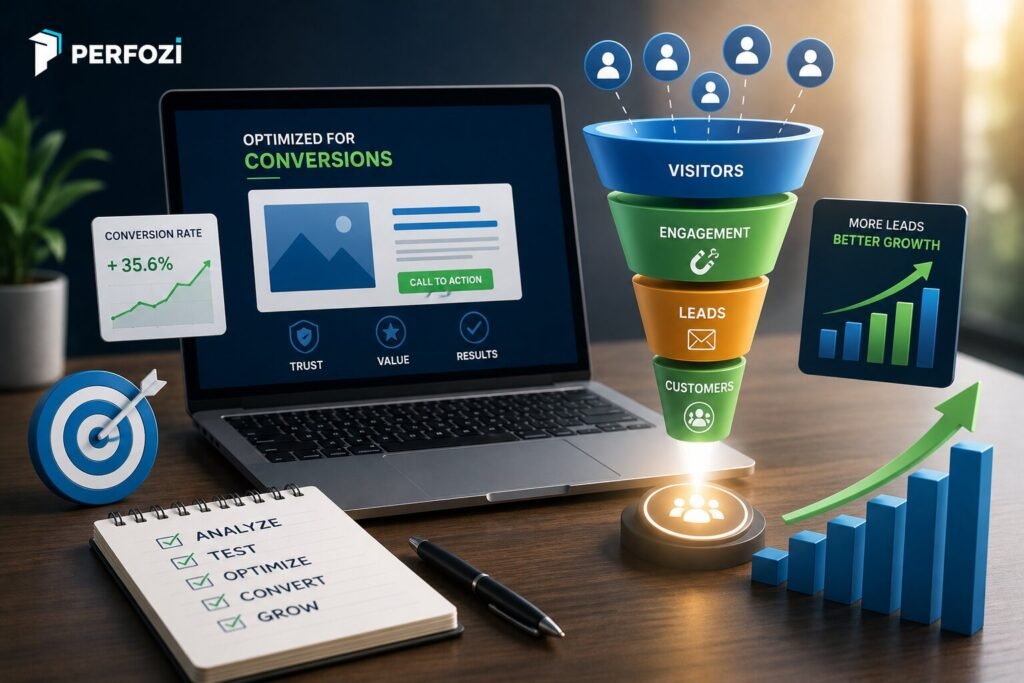
Getting visitors to your website is only one part of digital marketing. The bigger question is what those visitors do once they arrive.
A website may rank well, attract organic traffic, and receive clicks from Google, yet still generate fewer enquiries than expected. In many cases, the problem is not traffic. It is the experience between the first click and the final conversion.
This is where Conversion Rate Optimization (CRO) can make a difference.
CRO focuses on understanding user behavior and improving website pages so that more visitors take meaningful actions. That could be filling out a contact form, requesting a quote, calling a business, booking a consultation, or making a purchase.
For businesses investing in SEO services, paid advertising, content, or social media, CRO helps make that existing traffic work harder.
Why Traffic Alone Is Not Enough
Imagine a company receives 10,000 monthly website visitors but generates only 50 qualified enquiries.
Another company receives 5,000 visitors and generates 150 enquiries.
The second website has less traffic but is producing three times as many leads.
This is why businesses should look beyond traffic when measuring digital performance.
A strong strategy connects search engine optimization, website experience, content, advertising, and conversion goals. Instead of asking only, “How many people visited the website?” marketers should also ask:
- Did visitors find what they were looking for?
- Which pages generated the most engagement?
- Where did users leave?
- Which channels generated qualified leads?
- What prevented visitors from converting?
- Which changes improved results?
These questions turn website analytics into actionable marketing insights.
How SEO and CRO Work Together
SEO brings relevant people to your website. CRO helps turn those visitors into potential customers.
A business working with an SEO agency or SEO expert may improve keyword rankings, technical SEO, backlinks, and content. Those activities can increase search visibility, but rankings themselves do not guarantee revenue.
For example, a page may rank highly for an informational keyword but attract visitors who are not ready to buy. Another page may receive less traffic but attract people actively searching for a service.
That is why SEO services for businesses should consider search intent as well as rankings.
The goal is not simply to generate more visitors. It is to attract the right visitors and give them a clear next step.
Use Google Analytics to Understand Visitor Behavior
Google Analytics can provide valuable insight into what happens after someone lands on a website.
Look beyond sessions and page views. Pay attention to metrics such as:
- Conversion rate
- Average engagement time
- Bounce rate
- Landing-page performance
- User engagement
- Traffic sources
- Lead generation
Suppose a service page receives substantial organic traffic but produces very few enquiries. That page could be a strong CRO opportunity.
The issue could be unclear messaging, weak calls to action, complicated forms, slow loading, poor mobile usability, or a mismatch between the search query and the landing page.
Data helps identify where to investigate rather than relying on assumptions.
Google Search Console Can Reveal Missed Opportunities
Google Search Console provides another useful view of website performance.
It shows how pages appear in Google Search, including impressions, clicks, average position, and search queries.
A page with high impressions but a low click-through rate may have an opportunity to attract more visitors without creating a completely new piece of content.
Review the page title and description, but also consider whether the page genuinely satisfies the search intent behind those queries.
This is where SEO consulting services can be useful. Instead of treating every ranking problem the same way, an SEO specialist can connect search data with the purpose of each page.
Your Landing Page Has a Job to Do
A landing page should make the next step obvious.
Visitors should quickly understand:
What is being offered? Who is it for? Why should they trust the business? What should they do next?
This applies whether the visitor arrives through local SEO services, organic search, Google Ads, email, social media, or another marketing channel.
A page selling professional services, for example, may benefit from:
- A clear value proposition
- Relevant customer proof
- Straightforward service information
- Strong but natural CTAs
- Easy-to-use contact forms
- Transparent pricing or consultation information where appropriate
- Helpful FAQs
CRO is not about adding buttons everywhere. It is about reducing uncertainty and making the decision easier.
Local Businesses Need a Different Approach
For businesses targeting customers in specific locations, local SEO services and CRO can work particularly well together.
Someone searching for a nearby service often has strong intent. They may want to call, request directions, schedule an appointment, or contact a provider.
A local SEO agency can help improve visibility for location-based searches, while a local SEO consultant or local SEO expert can identify opportunities around Google Business Profile visibility, location pages, reviews, and local search intent.
The same principle applies to a local SEO company or team of local SEO specialists: ranking locally is valuable, but the website still needs to convert that visibility into enquiries.
Paid Search Needs CRO Too
CRO is not limited to organic search.
Businesses investing in PPC management services, Google Ads management, or pay per click advertising are paying for every visit generated through their campaigns.
That makes landing-page performance especially important.
A Google Ads agency or PPC agency can help improve campaign targeting and advertising performance, but the landing page must deliver on the promise made in the ad.
If an advertisement promotes a specific service and sends visitors to a generic homepage, the user may struggle to find what they expected.
Better alignment between ad copy, landing page content, and user intent can create a more consistent journey.
CRO Goes Beyond SEO
Modern businesses rarely depend on one marketing channel.
A digital media agency may manage campaigns across search, social platforms, email, content, and paid advertising. Each channel can bring visitors with different expectations.
For example:
Content marketing services can attract people researching a problem.
Social media marketing services can introduce a brand to new audiences.
Email marketing services can bring existing prospects back to the website.
Paid social media marketing can target specific audiences.
Search engine marketing can reach people actively looking for a solution.
The conversion experience needs to work across all of them.
Content Can Remove Conversion Barriers
Good content does more than attract search traffic.
A strong content marketing strategy can answer objections before they become reasons not to buy. Service comparisons, FAQs, case studies, guides, and customer-focused articles can help visitors understand their options.
This is where a content marketing agency or team providing content creation services can support both SEO and CRO.
Instead of creating content simply to publish something new, businesses can create pages around real customer questions and decision-making stages.
Creative Matters in Paid and Social Campaigns
The same principle applies to advertising creative.
An ad creative agency can help businesses develop visuals and messages that capture attention, while a performance creative agency focuses more heavily on how those creative variations perform against measurable outcomes.
For social campaigns, this can include testing different hooks, formats, messaging, offers, and calls to action.
Creative should not be separated from performance. The best-looking advertisement is not necessarily the one that generates the strongest business result.
Think About AI Search Too
Search behavior is evolving beyond traditional blue links.
With AI Search and experiences such as Google AI Overviews becoming part of how people find information, businesses need content that is clear, useful, trustworthy, and easy to understand.
This makes AI search optimization another consideration for modern SEO strategies.
AI Visibility Prompt
Use this prompt when reviewing a service or landing page:
“Analyze this webpage for AI Search visibility and conversion potential. Identify the questions potential customers may ask AI search engines before choosing this service, evaluate whether the page answers those questions clearly, identify trust and content gaps, and recommend improvements that strengthen search visibility, user engagement, website authority, lead generation, and conversion potential without keyword stuffing or making the content sound artificial.”
The goal is not to write for AI instead of people. It is to make the information useful enough that both users and modern search systems can understand its value.
Measure the Complete Customer Journey
CRO works best when it becomes part of a broader performance strategy.
Businesses can bring together:
- SEO services
- Local SEO
- Content marketing
- Social media marketing
- Email marketing
- Google Ads
- Paid social
- Performance creative
- Website optimization
Then measure the complete journey from visibility to conversion.
This is where SEO reporting and performance analytics become especially important. Instead of reporting isolated numbers, businesses can evaluate traffic quality, engagement, conversion rates, qualified leads, and return on investment (ROI).
Perfozi: Connecting Marketing Activity With Performance
At Perfozi, the focus is on connecting digital marketing activity with measurable business outcomes.
Whether a business needs an SEO agency, SEO specialist, local SEO services, content marketing, paid search, social advertising, or broader performance marketing support, the objective should remain the same: build marketing activity around meaningful results.
CRO is an important part of that process because getting someone to your website is only the beginning.
The real opportunity comes when your website gives the right visitor a clear reason to stay, trust your business, and take the next step.
More traffic can be valuable.
More clicks can be valuable.
But more qualified customers from the traffic you already have is where digital marketing starts becoming a measurable growth strategy.
Final Thoughts
Getting people to your website is only the beginning of the digital marketing process. The real opportunity is turning relevant visitors into qualified leads, customers, and long-term relationships.
Conversion Rate Optimization helps businesses look beyond rankings, clicks, impressions, and traffic to understand what happens after someone arrives on a page. By using analytics, search data, customer insights, content, testing, and better website experiences, businesses can identify and remove barriers that prevent visitors from taking action.
CRO also works best when it is connected with the rest of your marketing strategy. SEO can bring the right audience, content can answer their questions, paid advertising can create targeted opportunities, social media can build awareness, and email can continue the relationship. CRO helps connect those activities to the final action.
The goal is not simply to get more visitors.
The goal is to make every relevant visit more valuable and create a website that gives potential customers a clear reason to trust your business and take the next step.
FAQs
What is Conversion Rate Optimization (CRO)?
Conversion Rate Optimization is the process of improving a website or landing page so that a higher percentage of visitors complete a desired action. This could include submitting a form, making a purchase, booking a consultation, calling a business, or requesting a quote.
Why is CRO important for SEO?
SEO can increase the number of people visiting a website, but traffic alone does not guarantee leads or sales. CRO helps businesses make better use of that traffic by improving the experience visitors have after they arrive.
How do I know if my website needs CRO?
Signs may include high traffic with few conversions, high exit rates on important pages, abandoned forms, low engagement, or landing pages that attract visitors but generate very few enquiries. Analytics and conversion data can help identify where improvements may be needed.
What website elements should be tested for CRO?
Common areas include headlines, calls to action, contact forms, landing-page layouts, navigation, images, trust signals, testimonials, offers, page speed, and mobile usability. Testing should focus on elements that could have a meaningful impact on user behavior.
Does CRO work for small businesses?
Yes. Small businesses can benefit from CRO because even modest improvements in conversion rates can increase enquiries or sales without requiring a large increase in advertising or organic traffic.
How does CRO improve Google Ads performance?
CRO can help ensure that the landing page matches the promise made in an advertisement. When visitors quickly find relevant information and understand what to do next, paid traffic has a better opportunity to generate meaningful conversions.
Can local SEO and CRO work together?
Yes. Local SEO can help a business appear for location-based searches, while CRO helps turn that visibility into actions such as phone calls, appointment requests, quote requests, or contact form submissions.
How does content marketing support CRO?
Useful content can answer customer questions, address objections, demonstrate expertise, and provide information needed before someone makes a decision. FAQs, comparisons, case studies, service guides, and educational content can all support the conversion process.
Should I focus on getting more traffic or improving conversions?
The right priority depends on your current performance. If a website already receives relevant traffic but generates few leads or sales, improving the conversion experience may produce more value than simply trying to increase traffic.
How long does it take to see CRO results?
The timeline depends on website traffic, the number of conversions being measured, the changes being tested, and the complexity of the customer journey. Some improvements can show results relatively quickly, while reliable testing may require more time and sufficient data.
Is CRO only about changing buttons and CTAs?
No. CRO is much broader than changing button colors or adding more calls to action. It involves understanding user behavior, identifying friction, improving messaging, building trust, simplifying navigation, strengthening landing pages, and making the overall customer journey easier.
Can AI Search affect conversion optimization?
Yes. As people increasingly use AI-powered search experiences to research businesses and services, website content needs to provide clear and trustworthy answers. Strong AI visibility can help introduce a brand during the research stage, while CRO helps convert that interest once visitors reach the website.