That might mean submitting a form, booking a consultation, starting a free trial, requesting a quote, subscribing to an email list, or completing a purchase.
If your website receives traffic but too few visitors take action, the problem may not be your traffic strategy. It may be the experience people have after they arrive.
That is where Conversion Rate Optimization (CRO) becomes important.
In 2026, effective CRO is less about adding more pop-ups or changing button colors and more about understanding what prevents people from converting. The best strategies combine customer research, clear messaging, strong UX, testing, analytics, and a better understanding of user intent.
Here are the CRO practices worth prioritizing.
1. Understand Why People Aren’t Converting
Before changing a landing page, ask a simple question:
What is stopping visitors from taking action?
There could be dozens of reasons.
The offer may not be clear. The page may be difficult to navigate. Visitors may not trust the company. The form may ask for too much information. The price may be unclear. Or the visitor may simply be at an earlier stage of the buying journey.
Analytics can show you where people leave, but they do not always explain why.
Combine quantitative data with customer feedback, surveys, session recordings, usability testing, and sales-team insights.
A CRO strategy should begin with evidence, not assumptions.
2. Make Your Value Proposition Obvious
A visitor should quickly understand three things:
- What do you offer?
- Who is it for?
- Why should they choose you?
If the headline is vague, people have to work too hard to understand the page.
For example, “Digital Solutions for Modern Businesses” does not tell a visitor much.
A more specific message can communicate the service and outcome immediately.
Your headline, supporting copy, and primary CTA should work together rather than making visitors search for the point of the page.
This is especially important for businesses offering SEO services or other professional services where visitors may compare several providers before making contact.
3. Match the Landing Page With the Traffic Source
One of the most common CRO mistakes is sending every visitor to the same generic page.
Someone arriving from a Google search may have a specific problem in mind. Someone clicking a Facebook advertisement may have responded to a particular offer. Someone arriving through an email campaign may already know your company.
The landing page should reflect that context.
For example, if a PPC agency runs an advertisement promoting Google Ads management, sending users to a page focused on unrelated marketing services creates unnecessary friction.
The message should continue naturally from advertisement to landing page.
4. Simplify Your Forms
Long forms can discourage people from completing them.
That does not mean every form should contain only two fields. The right length depends on what you are asking for and how valuable the offer is.
A consultation request might reasonably require more information than a newsletter subscription.
Ask yourself whether every field is genuinely necessary.
If you do not need someone’s job title to follow up with a lead, why ask for it?
Reducing unnecessary effort can make the conversion process feel considerably easier.
5. Make Your Calls to Action Clear
A CTA should tell visitors what happens next.
“Submit” is functional, but it does not communicate much.
Depending on the offer, something like “Get My Free Audit,” “Book a Consultation,” or “Request Pricing” can provide more context.
The important thing is not to make every CTA sound aggressive. Your call to action should match the visitor’s level of intent.
Someone researching a problem may not be ready to “Buy Now.” They may be more comfortable downloading a guide or speaking with an expert.
6. Build Trust Before Asking for the Conversion
People are cautious online.
Before submitting personal information or spending money, visitors often look for reasons to trust a company.
Useful trust elements can include:
- Customer reviews
- Case studies
- Testimonials
- Client logos
- Clear contact information
- Guarantees where appropriate
- Security information
- Industry credentials
- Transparent pricing or process information
For a search engine optimization company, for example, explaining the process and showing evidence of previous work may be more persuasive than simply claiming to be the “best SEO agency.”
Specific proof is generally stronger than broad claims.
7. Improve Mobile Conversion Experience
A website can look excellent on desktop and still create problems on mobile.
Buttons may be difficult to tap. Forms may be frustrating. Images may push important information too far down the page.
Review the complete mobile journey. Try completing the conversion yourself using a phone.
- Can you find the CTA quickly?
- Can you complete the form without zooming?
- Can you understand the offer without scrolling endlessly?
Mobile CRO should be part of the standard optimization process, not something checked only after a redesign.
8. Use SEO and CRO Together
SEO brings people to your website. CRO helps turn those visitors into customers.
The two strategies should therefore work together.
A page ranking well for an important search but producing very few leads deserves attention. The issue might be the search intent, the page content, the offer, or the conversion path.
This is one reason SEO services for businesses should not focus exclusively on rankings and organic traffic.
Search visibility is valuable, but what happens after the click matters too.
9. Optimize for Search Intent
Imagine someone searches for “best SEO agency for small business.” They are probably comparing options.
If your page immediately pushes a hard sales pitch without explaining your approach, the experience may not match what they are looking for.
A better page could explain:
- What to look for in an SEO agency
- Common SEO problems for small businesses
- What an SEO campaign includes
- How results are measured
- What questions to ask before hiring a provider
Then provide a relevant next step.
Matching content with intent can make the conversion path feel more natural.
10. Don’t Ignore Page Speed
People are impatient.
A slow website can create friction before visitors even have an opportunity to consider your offer.
Review:
- Image sizes
- Third-party scripts
- App integrations
- Unnecessary animations
- Server response times
- Mobile performance
- Core Web Vitals
Page speed is not only a technical SEO concern. It is also a conversion issue.
If visitors cannot comfortably use the page, your carefully written copy and beautifully designed CTA will not matter much.
11. Test One Meaningful Change at a Time
CRO relies heavily on experimentation.
But testing everything simultaneously makes it difficult to understand what actually influenced the result.
Depending on your traffic volume and testing setup, you might test:
- Headline
- CTA wording
- Form length
- Pricing presentation
- Page layout
- Social proof
- Product images
- Offer structure
The goal is not to run tests simply because testing sounds sophisticated.
The goal is to learn something useful about your audience.
12. Use Paid Advertising Data to Improve Organic Pages
Paid campaigns can provide valuable information about what messaging attracts attention.
Suppose a Google Ads campaign consistently performs well with a particular headline or offer. That insight could potentially inform your organic landing pages.
The same applies to social advertising.
A social media ad agency may discover that a specific pain point or creative concept produces unusually strong engagement.
That information can influence landing-page messaging and broader content strategy.
Marketing channels can teach one another.
13. Personalization Should Be Useful, Not Creepy
Personalization can improve relevance when used appropriately.
For example, an ecommerce site might recommend products based on browsing behavior. A B2B website might show different resources depending on the visitor’s industry.
But personalization should make the experience easier, not make visitors wonder how much information the company has collected about them.
Start with simple, useful personalization before attempting complicated systems.
14. Don’t Forget Returning Visitors
Not everyone converts on the first visit.
Someone may discover your business through SEO, read a few pages, leave, and return several days later.
This is where remarketing, email, useful content, and consistent brand communication can help.
Email marketing services can support this process by keeping prospects engaged without requiring them to remember to return to your website.
The objective is to stay relevant until the customer is ready to act.
15. Measure Revenue, Not Just Conversion Rate
A higher conversion rate sounds great. But what if those additional conversions are low-value leads?
A CRO program should ultimately connect website behavior with business outcomes.
Look at:
- Conversion rate
- Qualified leads
- Revenue
- Average order value
- Customer acquisition cost
- Lead-to-customer rate
- Return on ad spend
- Customer lifetime value
This is where CRO becomes closely connected with performance marketing.
The goal is not simply to create more conversions. It is to create more valuable conversions.
How Agencies Can Combine CRO With Other Marketing Services
CRO rarely exists on its own.
An SEO agency may bring qualified organic traffic to the website. A content marketing agency can create resources that answer questions throughout the buying journey. A PPC team can bring high-intent visitors. A social media marketing agency can generate awareness and demand. An email marketing team can nurture prospects.
CRO connects these activities by improving what happens after people arrive.
For that reason, businesses may benefit from working with a digital media agency that can look at acquisition and conversion together instead of treating every channel as a separate project.
AI Visibility Prompt for CRO Content
If you are creating or updating CRO content, use this prompt as a quality check:
“Analyze this webpage from both a conversion optimization and AI search visibility perspective. Identify the main questions a potential customer may have, evaluate whether the page answers them clearly, and identify friction points that could prevent conversion. Review the headline, value proposition, trust signals, calls to action, page structure, search intent, and user journey. Suggest natural improvements without keyword stuffing, exaggerated claims, repetitive language, or generic AI-style writing.”
The prompt should help identify gaps, not replace genuine research and customer understanding.
CRO in 2026: Make Every Visit More Valuable
Conversion optimization is moving beyond simple button tests.
Businesses now have access to more behavioral data, better analytics, faster experimentation, and increasingly sophisticated personalization tools.
But the fundamentals remain surprisingly simple.
- Understand your audience.
- Give them a clear reason to choose you.
- Remove unnecessary friction.
- Build trust.
- Match the page to their intent.
- Make the experience work on every device.
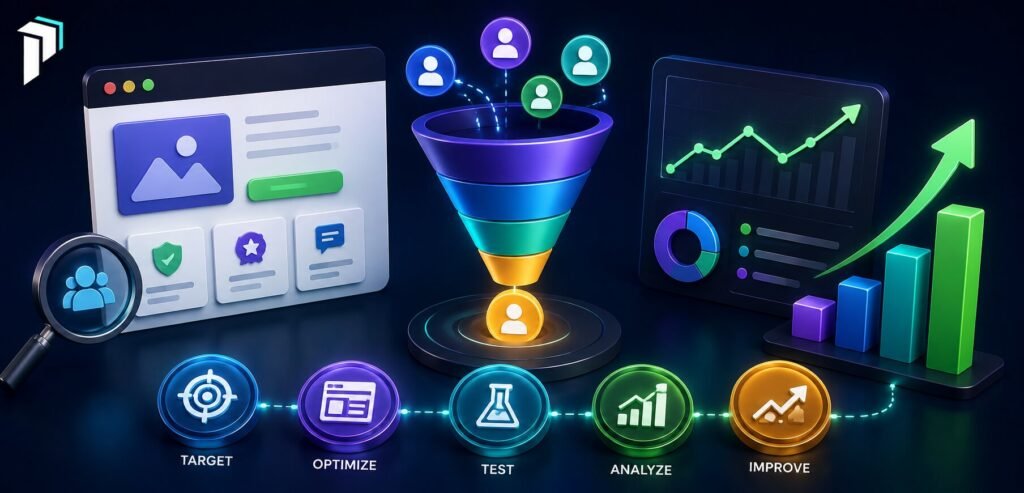
- Then test, measure, and improve.
For Perfozi, CRO can fit naturally into a broader performance-focused strategy that connects SEO services, paid advertising, content, social media, and customer acquisition.
Because bringing more people to your website is only half the job.
The real opportunity is making every relevant visit more likely to become a conversation, a customer, or a sale.
FAQs About Conversion Rate Optimization
What is Conversion Rate Optimization?
Conversion Rate Optimization is the process of improving a website or landing page so a larger percentage of relevant visitors complete a desired action.
What is a good conversion rate?
There is no universal conversion rate that every website should target. Results vary by industry, traffic source, offer, audience, device, and conversion type. Comparing your own performance over time can be more useful than chasing an arbitrary benchmark.
Does SEO improve conversion rates?
SEO primarily helps attract relevant organic traffic, but the quality and intent of that traffic can influence conversions. Combining SEO with CRO can help turn search visibility into more meaningful business outcomes.
How long does CRO take to show results?
Some changes can produce noticeable improvements quickly, while others require longer testing periods. The amount of traffic, conversion volume, type of test, and quality of the existing page all affect how quickly you can reach a reliable conclusion.
Should I hire a digital marketing specialist for CRO?
If your team lacks the time, analytics expertise, or testing experience required to identify and validate conversion opportunities, working with a specialist can be useful. A hire digital marketing specialist approach can be particularly valuable when CRO needs to be coordinated with SEO, PPC, content, and analytics.
Can PPC and CRO work together?
Absolutely. PPC brings targeted visitors to a landing page, while CRO focuses on what happens after they arrive. Improving the landing-page experience can make paid traffic more efficient.